
Why a Low Patient-to-Staff Ratio Matters in Detox

A low patient-to-staff ratio in a residential detox or small addiction treatment program is one of the strongest structural predictors of safer withdrawal, more individualized care, and a smoother transition to lasting recovery. Across residential and detox programs, what counts as a ‘low ratio’ varies: boutique programs have documented therapist caseloads as low as 4:1, while state regulations for inpatient nonhospital detoxification set a minimum staffing floor of one FTE primary care staff per seven clients during primary hours. Quality-oriented and dual-diagnosis programs often aim for daytime ratios closer to 1:4 or 1:5. When fewer people share each clinician’s attention, warning signs get caught earlier, medication adjustments happen faster, and the therapeutic relationship that research consistently ties to better outcomes actually has room to develop.
The mechanism is straightforward: more staff per resident means more observation time, shorter response windows during medical events, and clinicians who know each person’s history well enough to catch a subtle mood shift or a missed dose. That depth of attention is nearly impossible to replicate at scale.
What a genuinely low ratio gives you or your loved one:
- Faster clinical response if withdrawal complications arise overnight
- Daily or near-daily contact with a consistent primary clinician
- Medication-assisted treatment (MOUD) administered safely without overburdened nursing staff
- Aftercare planning that starts early and stays specific, not generic
Key Takeaways
A low patient-to-staff ratio in residential detox is a structural quality signal: it enables faster medical response, consistent clinician relationships, and aftercare planning that actually follows through.
Table of Contents
- What are the concrete benefits of a low patient-to-staff ratio?
- What does the research actually show — and where is it uncertain?
- How do facilities measure staffing, and what benchmarks should you know?
- Why does staffing ratio matter most during medically supervised detox?
- How do staffing levels affect therapy, engagement, and lasting benefit?
- What questions should you ask admissions before choosing a facility?
- How Connected Recovery operationalizes a low patient-to-staff ratio
- What I’ve seen that most families miss when evaluating programs
- Connected Recovery: medically supervised detox and residential treatment in Van Nuys
- Sources
What are the concrete benefits of a low patient-to-staff ratio?
The phrase “individualized care” gets used so often in treatment marketing that it has nearly lost meaning. In a well-staffed residential program, it has a specific operational definition: your clinician has enough time to review your chart before your session, not during it.
Research on boutique residential programs documents therapist caseloads as low as 4:1 and weekly treatment-plan reviews as standard practice. Those structural choices enable the kind of individualized care that larger programs describe in brochures but rarely deliver consistently.
The day-to-day gains families notice most:
- Consistent clinician assignment. The same counselor or therapist follows a client from intake through discharge, building the rapport that continuing care research ties to better longer-term outcomes.
- Fewer cancelled groups. Better-staffed programs run scheduled programming more reliably and have the bandwidth to coordinate community referrals at discharge.
- Faster medication adjustments. When nursing staff are not spread thin, MOUD dosing changes and withdrawal-protocol updates happen the same day, not two days later.
- Meaningful aftercare planning. A case manager who carries a small caseload can actually call the outpatient program, confirm the appointment, and hand off clinical notes.
Staffing levels shape what services a program can reliably deliver. Higher staff resources permit on-site medical care and the operational bandwidth for weekly plan reviews. (Multilevel facility characteristics and residential treatment outcomes)
What does the research actually show — and where is it uncertain?
The evidence is real but nuanced. A multilevel analysis of residential programs included staff-to-client ratio among its organizational variables and found associations with some outcomes, though the effects were limited and mixed across facilities. A realist synthesis of 28 studies reached a similar conclusion: program structure and staffing interact with client characteristics to produce outcomes, meaning staffing is a key contextual factor rather than a single cause.
A national survey of residential detox services in England found wide variability in staffing across units, with specialist detox units showing significantly more medical input and higher nursing-to-bed ratios than general wards. That variability matters: it means “residential detox” covers a wide range of actual staffing realities, and the label alone tells you nothing.
| What the evidence supports | What remains uncertain |
|---|---|
| Higher staffing is associated with fewer adverse events and higher patient satisfaction | Whether staffing alone causes better outcomes, or whether it correlates with other quality factors |
| Specialist detox units have more medical and nursing input than general wards | How much staffing is “enough” varies by client acuity and program model |
| Continuing care, strong counselor rapport, and individual counseling link to better outcomes | Optimal ratios for dual-diagnosis populations are not yet standardized |
| Program structure and staff composition interact with client context | Most studies are observational; randomized designs are rare |
The practical implication: staffing is a strong quality signal, but accreditation status, MOUD access, and clinical leadership matter alongside it.
How do facilities measure staffing, and what benchmarks should you know?
The industry uses two related terms. Staff-to-client ratio expresses how many staff members are available per resident (e.g., 1:4 means one staff member for every four clients). Client-to-staff ratio flips it (4:1). Both describe the same relationship; just confirm which direction a facility is using when they quote you a number.
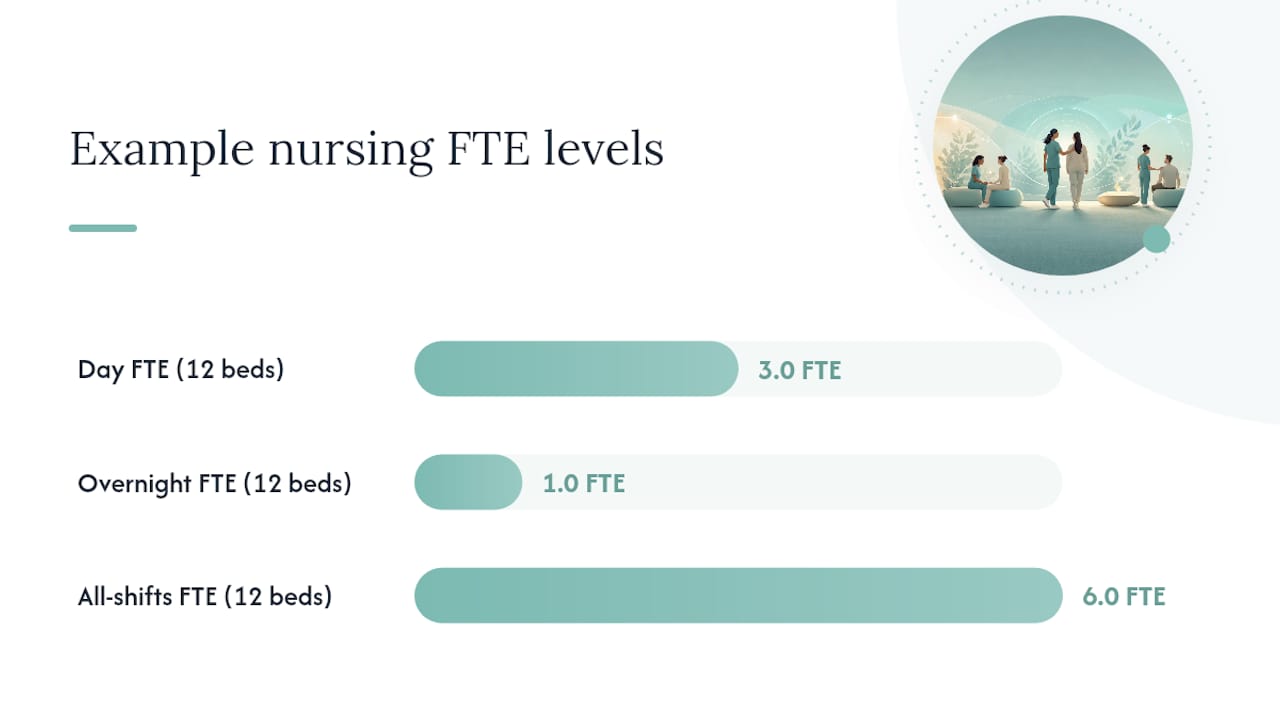
FTE (full-time equivalent) calculations matter because a program might list ten staff members while half work part-time. One FTE equals one full-time position. A 12-bed program with 3.0 FTE nursing staff on days and 1.0 FTE overnight has very different coverage than one with 6.0 FTE nursing across all shifts, illustrating how staffing varies by shift.
Pennsylvania’s regulations set an explicit minimum of one FTE primary care staff per seven clients during primary care hours for inpatient nonhospital detoxification. That is a regulatory floor, not a quality target. Higher-acuity programs and dual-diagnosis settings typically aim for ratios closer to 1:4 or 1:5 during daytime hours.
Roles that should count in any ratio you are quoted:
- Registered nurses (RN) and licensed practical nurses (LPN)
- On-site medical director or attending physician
- Licensed clinical social workers (LCSW) and licensed counselors
- Psychiatrist or psychiatric NP (especially for dual-diagnosis programs)
- Peer support specialists
Pro Tip: Ask admissions: “What is your daytime nurse-to-client ratio, and how many staff are physically on-site overnight?” A facility that hesitates or gives a combined day/night average is probably masking thin overnight coverage.
Why does staffing ratio matter most during medically supervised detox?
Withdrawal from alcohol, benzodiazepines, or opioids can escalate quickly. A client who is stable late in the evening can develop severe autonomic instability in the early morning hours. The difference between a good outcome and a medical emergency often comes down to how quickly a nurse notices and responds.

Higher staff-to-patient ratios in residential settings are associated with fewer adverse events, faster stabilization, and higher patient satisfaction. In detox specifically, that translates to more frequent vital-sign checks, timely administration of withdrawal protocols like CIWA-Ar scoring, and a nurse who is not managing eight other clients when yours needs attention.
Co-occurring psychiatric conditions add another layer. A client with untreated depression or a trauma history may show suicidal ideation during early withdrawal. Catching that requires staff who have time to observe, not just medicate and move on. The benefits of residential detox programs depend heavily on this kind of attentive, around-the-clock presence.
Checklist to verify overnight and emergency coverage:
- Are overnight staff awake and on-site, or on-call from off-site?
- What is the nurse-to-client ratio between midnight and 6 AM?
- Is there a physician or NP available by phone at all hours, with a protocol for in-person response?
- How are withdrawal scoring tools (CIWA-Ar, COWS) administered, and how often?
- What is the transfer protocol if a client needs emergency hospitalization?
Pro Tip: Request the facility’s emergency transfer protocol in writing before admission. A program confident in its medical oversight will provide it without hesitation.
How do staffing levels affect therapy, engagement, and lasting benefit?
Therapeutic alliance — the working relationship between a client and their clinician — is one of the most consistent predictors of treatment retention across addiction research. It does not develop in 50-minute sessions with a counselor who is managing 15 active cases. It develops when a clinician has time to read the previous session’s notes, notice a pattern, and bring it up unprompted.
Continuing care after residential rehab, strong rapport with counselors, and individual counseling are linked to better longer-term outcomes. That rapport starts in residential, and it requires staff time to build.
“Good care in residential rehabilitation requires tailoring, choreographing, and dialoguing — programmatic flexibility and resource intensity, including staff time, are central to delivering individualized treatment.” (Choreographing, tailoring and dialoguing care in residential rehab)
Person-centered care in residential SUD programs — peer support, family involvement, shared decision-making — also depends on staffing models that give clinicians time for individualized assessments and coordination.
Trust signals to verify before admission:
- CARF or The Joint Commission accreditation (ask for the certificate number)
- Published or available program completion rates
- Integrated MOUD capability on-site, not just by referral
- A documented aftercare planning process that begins in the first week
- Psychiatrist or psychiatric NP on staff for dual-diagnosis clients
What questions should you ask admissions before choosing a facility?
Most families feel uncomfortable pressing a treatment center for specifics. Ask anyway. A program with genuinely good staffing will answer these questions without defensiveness.
Questions to ask on the call:
- “What is your current client census, and what is your maximum capacity?”
- “How many RNs are on-site during the day shift, and how many overnight?”
- “Is overnight staff awake and physically present, or on-call?”
- “Who is my loved one’s primary clinician, and will that person stay consistent through discharge?”
- “Do you offer medication-assisted treatment on-site, or is it referred out?”
- “How often are treatment plans formally reviewed?”
Red flags to watch for:
- Vague answers like “we have adequate staffing” without numbers
- Overnight coverage described as “on-call” with no in-house staff
- High reliance on agency (temporary) staff for core clinical roles
- Groups that are frequently cancelled or combined
- No clear answer on who handles psychiatric emergencies
For dual-diagnosis needs, a lower ratio matters even more. Ask specifically whether the psychiatrist or psychiatric NP is on-site or remote, and how often they see each client.
A sample script for the call: “Before we discuss admission, I’d like to understand your staffing. Can you tell me your nurse-to-client ratio during the day and overnight, whether overnight staff are awake and on-site, and how often my family member would meet with their primary counselor?”
For a broader decision guide on questions to ask detox facilities, Connected Recovery has published a practical checklist families can use.
How Connected Recovery operationalizes a low patient-to-staff ratio
Connected Recovery is a modestly sized boutique facility in Van Nuys, Los Angeles, built around the premise that census size is a clinical decision, not just a business one. Twelve beds is not a marketing choice; it is the number at which consistent clinician assignment and daily clinical contact remain operationally sustainable.
Trust signals Connected Recovery offers:
- 24/7 on-site medical supervision with an on-site medical director
- Credentialed clinical staff: RNs, LCSWs, MD/psychiatrist, and certified addiction specialists
- MOUD capability on-site for opioid and alcohol use disorders
- Integrated dual-diagnosis treatment for co-occurring mental health conditions
- Weekly treatment-plan reviews with the primary clinician
- Structured aftercare planning that begins in the first week of admission
- State licensing and accreditation standards met for residential and detox levels of care
At 12 beds, the boutique rehab model means a client is never one of 40. Clinicians know each person’s history, family situation, and psychiatric background. When a medication needs adjusting at 11 PM, the nurse on shift is not choosing between six other urgent tasks.
Families can ask Connected Recovery directly about current census, staff credentials, and program completion metrics during the intake pre-screen call.
Pro Tip: Ask any facility: “What is your average length of stay for detox, and what percentage of detox clients transition directly into residential?” That single question reveals how well the program coordinates continuity of care.
What I’ve seen that most families miss when evaluating programs
The staffing ratio conversation tends to focus on daytime numbers, and that is where facilities look best. The real test is overnight. A program can have excellent day-shift ratios and run a skeleton crew from 11 PM to 7 AM, which is precisely when withdrawal complications peak for alcohol and benzodiazepine detox.
Families also underestimate the difference between a psychiatrist who visits once a week and one who is integrated into daily clinical rounds. For someone with co-occurring depression, PTSD, or bipolar disorder, that difference is not administrative. It determines whether a medication crisis gets caught on day two or day eight.
The evidence on staffing ratios is associational, not causal, and I think that framing actually undersells the point. The studies show associations because it is nearly impossible to randomize people to understaffed programs. The mechanism is obvious to anyone who has watched a nurse manage eight withdrawing clients alone overnight: things get missed. The research confirms what clinical common sense already says.
When you call a facility, the quality of their answers to staffing questions tells you as much as the numbers themselves. Confidence, specificity, and a willingness to put it in writing are the signals worth trusting.
Connected Recovery: medically supervised detox and residential treatment in Van Nuys
Connected Recovery offers medical detox and residential treatment in Van Nuys, CA, with integrated dual-diagnosis care and on-site MOUD for adults who need more than a standard program can provide. The 12-bed census keeps staffing ratios low enough to deliver what this article describes: daily clinical contact, consistent clinician assignment, 24/7 medical supervision, and aftercare planning that starts before discharge, not after.
Private pay and most major insurance plans are accepted. To find out whether Connected Recovery is the right fit, call admissions or request an intake pre-screen. Come prepared with the staffing questions from this article, and expect straight answers.
Sources
- Multilevel facility characteristics and residential treatment outcomes
- Realist synthesis of community-based residential treatments
- What Works in Residential Rehabilitation for Alcohol and Other Drug Treatment (2024)
- 28 Pa. Code § 704.12. Full-time equivalent (FTE) maximum client/staff and client/counselor ratios.
- National survey of residential drug detox services (England)
- Built Small on Purpose: Inside Simple Path Recovery’s Boutique Model
- Operationalizing person-centered care in residential substance use treatment
When evaluating any facility, ask for their accreditation certificate number, current staffing ratios by shift, and any available program completion or aftercare engagement metrics. A program confident in its quality will provide all three.
This article is general information, not a substitute for advice from a qualified doctor. Consult a qualified healthcare professional about your own circumstances before acting on anything here.
Recommended
- What Is a Safe Detox Environment: A Clear Guide | Connected Recovery Inc.
- Inpatient vs Outpatient Detox: Which Is Right for You? | Connected Recovery Inc.
- Questions to Ask Detox Facilities: A Decision Guide | Connected Recovery Inc.
- How to Track Progress During Detox Effectively | Connected Recovery Inc.
DHCS Licensed · Joint Commission Accredited
If you or a loved one is struggling with substance use, our admissions team is available to verify your insurance benefits and help you begin recovery. All calls are confidential.