
Blog
Clinicians: 5–10% Every 2–4 Weeks, Benzodiazepine Taper Synthesis
Clinicians: 5–10% Every 2–4 Weeks, Benzodiazepine Taper Synthesis

Taper a benzodiazepine when the risks of continued use outweigh its benefits, and reach that conclusion through shared decision-making with the patient, not unilateral withdrawal of the prescription. The guideline-backed pace for most patients is a gradual dose reduction every 2–4 weeks. Clinicians should generally avoid large cuts in any two-week span. The Joint Clinical Practice Guideline on Benzodiazepine Tapering and the AAFP summary both anchor this pace, and Connected Recovery sees the downstream cases when tapers move faster than that.
TL;DR:
- Most benzodiazepine tapers should progress slowly, reducing by 5-10% every 2-4 weeks, with slower pace advised for high-dose or long-term users.
- Large dose reductions in less than two weeks are generally unsafe, especially for patients with seizure history, autonomic instability, or active substance intoxication.
- Monitoring must be risk-based, with weekly contact during the initial phase and pauses or slowing of the taper if withdrawal symptoms or adverse events emerge.
- Converting short-acting benzodiazepines to longer-acting agents like diazepam can improve withdrawal stability but requires cautious use in older adults or hepatic impairment.
- Patients with complex histories, safety concerns, or high risk should be referred to residential detox or treatment facilities, not outpatient management alone.
Table of Contents
- What Do the Benzodiazepine Taper Guidelines Actually Recommend?
- Clinician Checklist: Top Recommendations and Red Flags
- Designing the Taper: Rates, Sequencing, and Dose Conversion
- Monitoring for Seizure Risk and Escalation Criteria
- Which Adjunctive Supports Actually Help a Taper Succeed?
- How Should Tapering Differ for Older Adults and Other High-Risk Groups?
- What Do Practical Percent-Based Taper Schedules Look Like?
- When Does a Patient Need Referral to Residential Withdrawal Management?
- Where Can Clinicians Find the Full Guidelines?
- The Real Gap Between Guideline and Bedside
- A Safety Net for Tapers That Need More Than an Outpatient Visit
- Sources
- FAQ
What Do the Benzodiazepine Taper Guidelines Actually Recommend?
The core numeric rule is simple enough to write on a prescription pad: reduce the dose by a small, gradual amount every two to four weeks, and treat any larger reduction in a short timeframe as a ceiling, not a target. The Joint Clinical Practice Guideline, developed with input reflecting American Society of Addiction Medicine consensus processes, frames this as a starting point that gets adjusted against how the patient actually responds, not a fixed countdown.
That flexibility matters more than the exact percentage. A patient with a decade of continuous use, a seizure history, or heavy alcohol use needs a materially slower approach than someone six months into a short-term prescription for situational insomnia. The guideline’s recommendations carry varying strength, from strong statements on shared decision-making to more conditional guidance on adjunctive pharmacotherapy, which is a signal in itself: the field has firm consensus on pace and monitoring, and much less certainty on what to add alongside the taper.
Pro Tip: Document the taper plan as a range, not a fixed schedule. “5 to 10% every 2 to 4 weeks, adjusted based on symptoms” protects both the patient and the record if the pace needs to slow.
Clinician Checklist: Top Recommendations and Red Flags
Before writing the first reduced dose, confirm the plan against a short list of non-negotiables.
- Start with 5–10% reductions every 2–4 weeks; never exceed 25% in a two-week window without a specific clinical reason.
- Consider converting to a longer-acting agent like diazepam when a patient is on a short-acting benzodiazepine or has struggled with interdose symptoms.
- Reassess risk versus benefit with the patient at least every 3 months, per the AAFP summary.
- Slow or pause the taper if withdrawal symptoms outpace the patient’s tolerance rather than pushing through on schedule.
- Reserve inpatient or residential care for complicated histories, not routine outpatient tapers.
Immediate red flags that override any taper schedule: a history of withdrawal seizures, severe autonomic instability (rapid heart rate, high blood pressure, fever), concurrent intoxication from alcohol or other sedatives, and active suicidality. Any one of these warrants stopping the taper and reassessing level of care the same day.
For documentation, a monthly follow-up cadence works for most low-risk outpatient tapers, with weekly contact (in person or via telehealth) during the first month of any dose change. Pull a PDMP report before starting and at each risk reassessment.
Designing the Taper: Rates, Sequencing, and Dose Conversion
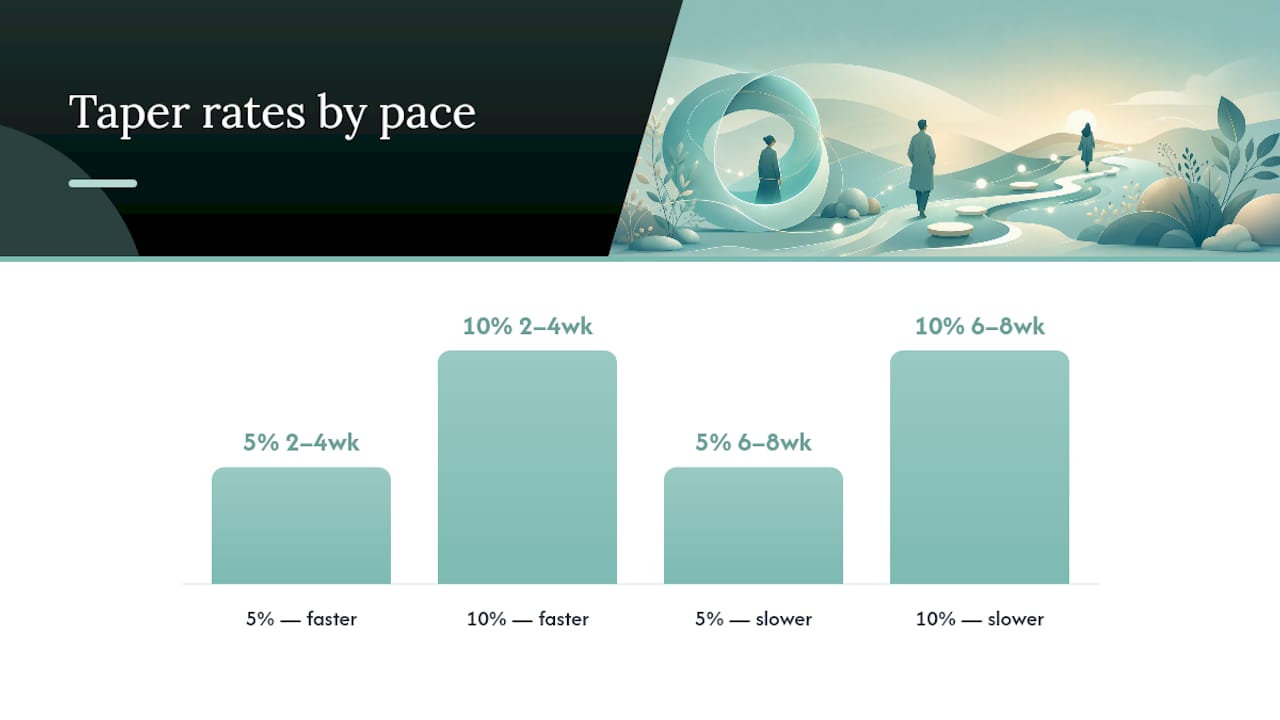
The 5–10% starting point is not one-size-fits-all. Patients with high-dose, long-duration use, prior withdrawal seizures, or significant psychiatric comorbidity often do better on a slower track, sometimes 5–10% every 6–8 weeks rather than every 2–4. Faster reductions are almost never justified on pace alone; they’re reserved for safety scenarios like acute overdose risk from polysubstance combinations, where the calculus shifts entirely.
Calculating the actual step is arithmetic, but it gets tricky at low doses. The Ashton Manual has answered this for decades with practical workarounds:
- Tablet-splitting for scored formulations, where the strength allows a clean half or quarter dose.
- Compounded liquid formulations that allow measured reductions in fractions of a milligram.
- Alternate-day dosing near the end of a taper, once daily reductions become impractical.
Converting a short-acting agent like alprazolam or lorazepam to a longer-acting one such as diazepam smooths out interdose withdrawal and simplifies the math, since diazepam’s long half-life buffers the peaks and troughs that make short-acting agents harder to taper. The tradeoff is real in older adults or anyone with hepatic impairment: diazepam’s active metabolites accumulate more unpredictably when clearance is reduced, so the conversion isn’t automatic just because it’s convenient.
Sequencing also depends on what symptom the benzodiazepine was treating. If insomnia is the primary complaint, reduce the morning dose first; if daytime anxiety dominates, reduce the evening dose first. This detail, drawn from the AAFP guideline summary, keeps the taper from immediately reigniting the symptom it was prescribed to control.
Monitoring for Seizure Risk and Escalation Criteria
A taper plan is only as good as the monitoring behind it. Before the first dose reduction, work through a short pre-taper checklist:
- Screen for a history of withdrawal seizures or a seizure disorder, which changes both pace and setting.
- Review the medication list and PDMP for other sedatives, especially opioids.
- Assess current alcohol use, since heavy or binge drinking dramatically raises withdrawal seizure risk.
- Screen for active psychiatric comorbidity, particularly mood disorders that can worsen during dose reduction.
Monitoring cadence should scale with risk. Low-risk outpatient tapers can run on monthly visits once stable; higher-risk patients need weekly contact, and telehealth check-ins make that frequency sustainable without overloading clinic schedules. Structured withdrawal scales help standardize what “worse” means from one visit to the next rather than relying on subjective impression alone.
Pause or slow the taper, and consider returning briefly to the prior dose, whenever symptoms escalate faster than the patient can tolerate, especially autonomic instability or emerging seizure activity. Refer to inpatient or residential care when a patient has a history of complicated withdrawal, active polysubstance dependence, or any imminent safety concern that outpatient follow-up can’t cover. The benzo detox timeline outlines what that escalation typically looks like in a supervised setting.
Which Adjunctive Supports Actually Help a Taper Succeed?
Behavioral therapy has the strongest evidence base of anything offered alongside a taper. Cognitive behavioral therapy, and CBT‑I specifically for insomnia, both show consistent benefit and the guideline recommends offering them where relevant rather than treating them as optional add-ons.
Pharmacologic adjuncts are a different story. Evidence for routinely adding another medication to ease benzodiazepine withdrawal is limited, so use should be selective rather than default:
- Antidepressants when a co-occurring mood or anxiety disorder is driving symptoms independent of withdrawal.
- Anticonvulsants in select cases with seizure risk history, under specialist guidance.
- Sleep-focused nonpharmacologic strategies before reaching for a substitute hypnotic.
Coordinate with behavioral health and substance-use services early rather than after a taper stalls, and loop in a spouse or family member where the patient consents. A partner who knows the warning signs often catches deterioration before the next scheduled visit does. Resources on the Life Is a Game mental health blog offer useful digital-tool concepts for patients managing anxiety between appointments, and the practice’s own guide to coping with withdrawal and anxiety gives patients something concrete to hold onto between visits.
How Should Tapering Differ for Older Adults and Other High-Risk Groups?
Age and comorbidity change the calculus considerably. In adults 65 and older, tapering is favored in most cases given the accumulated fall, cognitive, and sedation risks of long-term use, but the pace needs to slow further, and routine conversion to a long-acting agent like diazepam should be approached cautiously since reduced hepatic clearance lets active metabolites build up unpredictably.
- Older adults: favor a slower taper over indefinite continuation; avoid automatic long-acting substitution when clearance is impaired.
- Co-prescribed opioids or active substance use disorder: intensify monitoring, coordinate opioid use disorder treatment before or alongside the taper, and consider a naloxone prescription given the added respiratory depression risk.
- Pregnant or lactating patients: individualize the risk-benefit discussion; if continuation is necessary, lorazepam is often preferred, and neonatal withdrawal along with breastfeeding exposure need explicit discussion with the patient.
For opioid-involved cases, the same seizure-risk vigilance used in tramadol withdrawal management applies directly, given the overlapping mechanisms.
What Do Practical Percent-Based Taper Schedules Look Like?
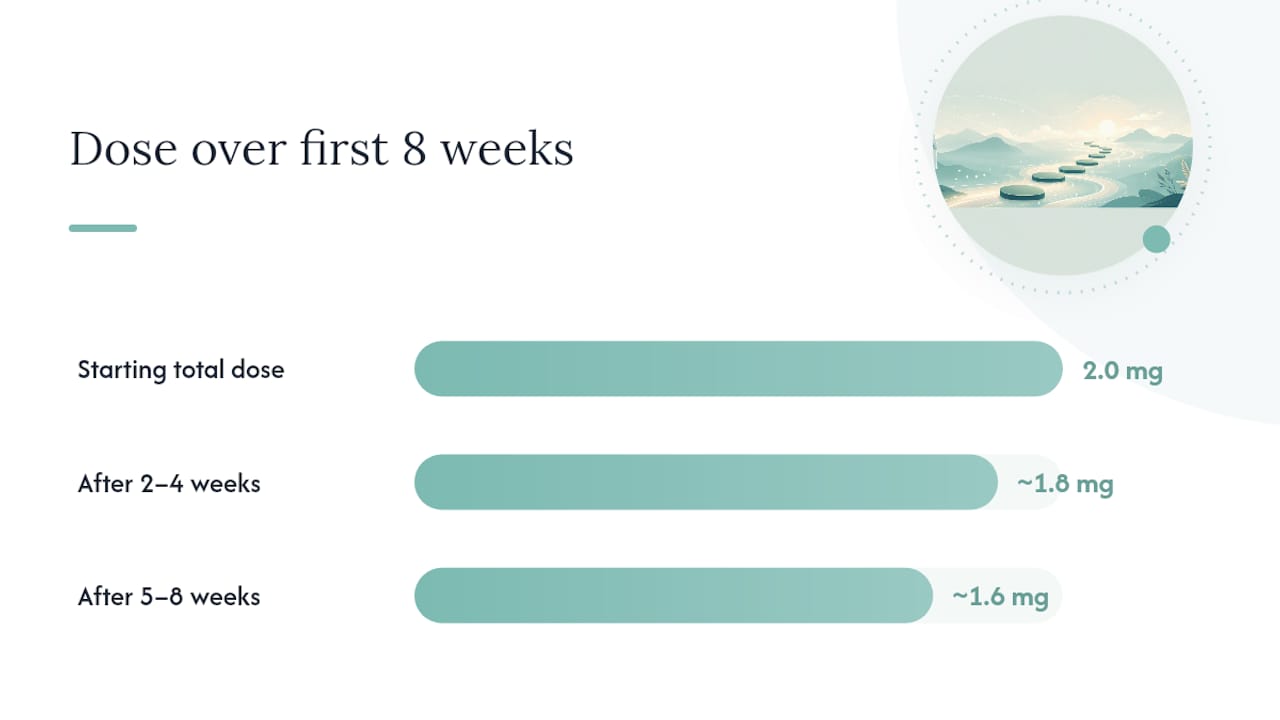
Numbers make the abstraction concrete. Here’s how a standard taper plays out for a patient on 1 mg of lorazepam twice daily, a common enough starting point that it’s worth walking through step by step.
- Week 1 to 4: reduce total daily dose by roughly 5–10%, moving from 2 mg to about 1.8 mg daily, split however the patient’s symptom pattern dictates.
- Week 5 to 8: repeat the 5–10% reduction against the new total, landing near 1.6 mg daily, adjusting the split between morning and evening doses based on which symptom dominates.
- Continue in 2 to 4 week increments, extending the interval to 6–8 weeks if withdrawal symptoms emerge, until reaching the smallest measurable dose.
For alprazolam and other short-acting agents, the same math applies less cleanly because interdose withdrawal shows up between scheduled doses. That’s usually the trigger to convert to diazepam before starting the percent-based reductions rather than tapering the short-acting agent directly.
Pro Tip: Give patients the written schedule with actual dates, not just percentages. “Reduce to 0.9 mg on March 15” lands very differently than “cut by 10% next visit,” and it cuts down on anxious calls between appointments.
Document informed consent in plain language: “We’ve discussed that withdrawal symptoms including anxiety, insomnia, and rebound symptoms are expected during tapering, and we’ve agreed on a plan to slow the pace if symptoms become difficult to manage.”
When Does a Patient Need Referral to Residential Withdrawal Management?
Most benzodiazepine tapers succeed in an outpatient setting with the right monitoring cadence. Some don’t, and recognizing that early protects the patient more than any adjustment to the outpatient schedule.
Some residential programs operate smaller facilities with 24/7 medical supervision alongside individualized treatment planning rather than a one-size-fits-all protocol, which can benefit patients tapering benzodiazepines alongside co-occurring mental health conditions.
Referral thresholds worth flagging to a residential program include:
- A documented history of withdrawal seizures or delirium during a prior taper attempt.
- Active polysubstance dependence, particularly alcohol or opioids alongside the benzodiazepine.
- Outpatient monitoring capacity that can’t match the patient’s risk level.
- Any imminent safety concern, including suicidality tied to withdrawal symptoms.
When transferring a patient, send the current medication list, taper history including doses and dates, PDMP results, and psychiatric history so the receiving team can pick up the plan without starting from zero.
Where Can Clinicians Find the Full Guidelines?
- The Joint Clinical Practice Guideline for the full recommendation grading and special-population guidance.
- The AAFP practice-guideline summary for a condensed clinical reference.
- The Oregon Health Authority taper guide for stepwise, practice-ready schedules.
- The Ashton Manual for detailed slow-withdrawal protocols and substitution guidance.
The Real Gap Between Guideline and Bedside
The guidelines are not the hard part. Every major source agrees on the same basic pace, the same emphasis on shared decision-making, the same caution around abrupt discontinuation. The hard part is that most benzodiazepine tapers fail somewhere between the exam room and the pharmacy, not because the plan was wrong on paper, but because nobody checked in during week three when the patient’s sleep fell apart and they quietly stopped following the schedule.
Where conventional advice falls short is treating the taper as a math problem: pick a percentage, pick an interval, done. The patients who actually finish are the ones whose clinicians built in real monitoring, adjusted the pace out loud rather than silently, and had a specific plan for what happens if things get worse. That’s not a footnote to the guideline. It’s the guideline, since shared decision-making and reassessment every three months are recommendations with real teeth, not procedural boilerplate.
If there’s one place to prioritize effort, it’s the pre-taper conversation, not the spreadsheet of dose reductions. A patient who understands what to expect and has a clear escalation plan will tolerate a bumpy taper far better than one handed a schedule with no context.
— Jim
A Safety Net for Tapers That Need More Than an Outpatient Visit
Some patients can’t taper safely in a monthly follow-up model, and that’s exactly the gap Connected Recovery exists to close. Its 12-bed facility in Van Nuys runs 24/7 medical supervision with individualized treatment plans, built for patients whose benzodiazepine dependence overlaps with a co-occurring mental health condition, prior complicated withdrawal, or polysubstance use that outpatient monitoring can’t safely manage.

For clinicians weighing a referral, medical detox covers the acute withdrawal phase with continuous medical monitoring, while residential treatment extends that supervision into the weeks that follow, when protracted withdrawal symptoms are still a real risk. Patients whose benzodiazepine use is tangled up with anxiety, depression, or another psychiatric diagnosis benefit from the dual diagnosis program, which treats both conditions under one integrated plan instead of routing the patient between separate providers.
If a patient needs a higher level of care than outpatient monitoring can support, clinicians should consider contacting appropriate residential treatment centers to discuss admission and coordinate transfer plans directly with clinical teams.
This article is general information, not a substitute for advice from a qualified doctor. Consult a qualified healthcare professional about your own circumstances before acting on anything here.
Sources
- Joint Clinical Practice Guideline on Benzodiazepine Tapering: Considerations When Benzodiazepine Risks Outweigh Benefits
- Practice Guidelines | Benzodiazepine Tapering: Joint Guidelines From the American Society of Addiction Medicine (AAFP summary)
- How to approach a benzodiazepine taper (Oregon Health Authority)
- Ashton Manual
FAQ
What Are the Current Guidelines for Tapering Benzodiazepines?
The Joint Clinical Practice Guideline recommends initial reductions of 5–10% every 2–4 weeks, generally not exceeding 25% in any two-week period, adjusted based on how the patient tolerates each step. Shared decision-making and risk-benefit reassessment at least every 3 months, per the AAFP summary, round out the core framework.
What Is the Ashton Protocol for Tapering Benzodiazepines?
The Ashton Manual is a detailed, patient-centered slow-withdrawal approach developed by Professor Heather Ashton, built around converting short-acting benzodiazepines to diazepam and then reducing in small, individualized steps, often more gradually than the standard guideline pace when a patient has struggled with prior attempts. It remains widely referenced for its practical tablet-splitting and liquid-dosing guidance.
What Are the New Guidelines for Prescribing Benzodiazepines?
Recent guidance emphasizes limiting new prescriptions to the lowest effective dose for the shortest duration, screening for risk factors like alcohol use and psychiatric comorbidity before starting, and building an exit plan into the initial prescribing conversation rather than treating benzodiazepines as an open-ended treatment. The same Joint Clinical Practice Guideline that governs tapering also shapes these prescribing recommendations.
How Do You Taper Off 0.5 mg of Lorazepam?
This is the exact scenario the Ashton Manual addresses in detail, and it’s worth slowing the interval to 6–8 weeks per step if the patient reports any withdrawal symptoms during the process.
When Should a Patient Be Referred for Inpatient Benzodiazepine Withdrawal Management?
Referral is appropriate when a patient has a history of withdrawal seizures, active polysubstance dependence, or safety concerns that outpatient monitoring can’t adequately cover. Programs like Connected Recovery’s medical detox provide the 24/7 supervision that complicated tapers require.
Recommended
DHCS Licensed · Joint Commission Accredited
If you or a loved one is struggling with substance use, our admissions team is available to verify your insurance benefits and help you begin recovery. All calls are confidential.