
6 Things to Bring to a Bipolar and Addiction Assessment

Bipolar disorder and addiction co-occur often enough that clinicians treat the pairing as the expectation, not the exception, and recommended approach is integrated treatment that addresses both conditions at the same time. If you or someone you love is in crisis, showing signs of psychosis, or expressing suicidal thoughts, call or text 988 or dial 911 now. Otherwise, the next steps are a proper dual assessment and a treatment plan built around both diagnoses. The sections ahead cover the numbers, assessment process, medication safety, and the specific questions worth asking any program.
TL;DR:
- Effective treatment requires concurrent, coordinated care for both bipolar disorder and addiction, rather than sequential or separate approaches.
- A thorough assessment over time, including a medication and substance use history, collateral reports, and toxicology tests, is essential for accurate diagnosis.
- Medications like mood stabilizers and antipsychotics are primary for bipolar, while addiction treatments such as buprenorphine or methadone must be managed with psychiatric oversight.
- Integrated therapy options, including group therapy, CBT, IPSRT, and family support, target both mood regulation and substance use relapse prevention.
- Small, boutique treatment centers offering continuous medical supervision and seamless transition from detox to ongoing care improve long-term recovery prospects.
Table of Contents
- How Common Is the Link Between Bipolar Disorder and Addiction?
- How Do Doctors Tell Bipolar Symptoms Apart From Substance Use?
- Why Integrated Treatment Works Better Than Treating One Condition First
- What Medications Are Safe for Bipolar Disorder and Addiction Together?
- What Therapy Approaches Help With Both Conditions?
- What Should You Know About Detox and Residential Treatment?
- How Do You Prevent Relapse After Stabilization?
- What Does an Integrated Dual-Diagnosis Program Actually Look Like?
- What Screening Tools Help Identify Co-Occurring Bipolar Disorder and Addiction?
- Why Do People With Dual Diagnosis Struggle to Stay in Treatment?
- How Does This Affect Relationships, Work, and Family Life?
- What Special Considerations Apply to Adolescents, Pregnant Women, and Older Adults?
- What Is the Long-Term Outlook for Bipolar Disorder and Addiction?
- An Honest Perspective on Treating Bipolar Disorder and Addiction
- Getting Help From Connected Recovery for Bipolar and Addiction
- Sources
- FAQ
How Common Is the Link Between Bipolar Disorder and Addiction?
Roughly 21.2 million adults in the United States had both a mental illness and a substance use disorder in a recent year, according to SAMHSA’s National Survey on Drug Use and Health. That figure covers all mental illness categories, not bipolar disorder alone, but it establishes the baseline reality clinicians work from: co-occurrence is common, and treating one condition while ignoring the other rarely works.
For bipolar disorder specifically, a foundational clinical resource on substance use disorder treatment for people with co-occurring disorders describes comorbidity between bipolar I disorder and substance use disorders as closer to a rule than an exception in clinical populations. Exact prevalence figures shift depending on whether researchers measure lifetime exposure or past-year use, and depending on whether the sample comes from a general population survey or a psychiatric inpatient unit. Inpatient and treatment-seeking samples tend to show much higher overlap than community surveys, which makes sense: people whose mood symptoms and substance use are colliding are the ones most likely to end up in a hospital or a residential program.
Why the two conditions travel together:
- Self-medication. Alcohol or sedatives can temporarily blunt the racing thoughts and agitation of a manic episode; stimulants can offer a jolt out of bipolar depression’s flatness. The relief is real and short. The rebound is worse.
- Impulsivity and urgency. Mania and hypomania often come with increased risk-taking and poor judgment about consequences, which makes experimenting with substances, and continuing to use them, more likely during mood episodes.
- Shared neurobiology. Dopamine and reward-circuit irregularities implicated in bipolar disorder overlap substantially with the brain systems addiction hijacks, which may partly explain why the two conditions cluster in the same people and often in the same families.
- Trauma history. Adverse childhood experiences and trauma raise the risk for both bipolar disorder and substance use disorders independently, so a shared trauma history can drive both conditions rather than one causing the other.
The clinical consequences of this overlap are not subtle. The same NCBI clinical resource on co-occurring disorders links bipolar and SUD comorbidity to more frequent hospitalization, weaker functional recovery between episodes, and meaningfully higher suicide risk than bipolar disorder alone carries. That is the case for urgency, not despair: the risks are exactly why integrated assessment matters so much, and why waiting to “get sober first” before addressing mood, or waiting to “stabilize mood first” before addressing substance use, tends to backfire.
How Do Doctors Tell Bipolar Symptoms Apart From Substance Use?
Intoxication and withdrawal can look almost identical to a mood episode. Stimulant intoxication mimics mania: racing speech, grandiosity, reduced need for sleep, and irritability. Alcohol or sedative withdrawal can trigger anxiety, insomnia, and agitation that looks like a mixed episode. A clinical review of co-occurring bipolar and substance use disorders notes that this symptom overlap, spanning insomnia, agitation, and impulsivity, is exactly what makes a single crisis-room presentation such an unreliable place to assign a permanent psychiatric diagnosis.
The fix is not a smarter test. It is a longer timeline. Clinicians rely on history gathered across sober stretches, not just the moment someone walks in intoxicated or in withdrawal, plus collateral information from family members who watched the pattern unfold over months or years. A single snapshot tells you almost nothing reliable; a pattern across weeks tells you a great deal.
What to bring to an assessment (or help a loved one bring):
- A timeline of current and recent psychiatric medications, including doses and any recent changes.
- The date and substance of last use, plus a rough history of use patterns over the past year.
- Any prior withdrawal experiences, especially anything involving seizures, hallucinations, or medical hospitalization.
- A list of prior manic, hypomanic, or depressive episodes, with approximate dates and severity.
- Any past psychiatric hospitalizations and their triggers.
- Honest documentation of any suicidal thoughts, plans, or attempts, past or present.
Bringing a complete medication and substance use timeline to the first evaluation measurably improves diagnostic accuracy and makes medication changes safer, according to VA/DoD clinical guidance on bipolar disorder. Beyond history-taking, clinicians use a few concrete tools to sort out what is actually happening: urine or blood toxicology to confirm recent substance use, direct observation during a supervised abstinence period to see which symptoms persist once a substance clears the system, and structured sleep and behavior logs kept over days or weeks.
Pro Tip: Keep a simple daily log, even a note on your phone, tracking sleep hours, mood, energy, and any substance use. A week or two of this data is often more diagnostically useful to a clinician than an hour of recalling things from memory during a crisis visit.
Why Integrated Treatment Works Better Than Treating One Condition First
Integrated treatment means a substance use disorder and a mental health condition like bipolar disorder are treated concurrently, by a coordinated team, rather than one after the other. SAMHSA’s guidance on co-occurring disorders identifies this concurrent, coordinated model as the best-practice standard across treatment settings, and for good reason: bipolar symptoms and substance use constantly feed each other, so treating them on separate tracks or in sequence leaves an active feedback loop untouched.
That stands in contrast to two older models still common in fragmented care systems. In a sequential model, a person gets treated for addiction first and mood symptoms are addressed only after they achieve some sobriety, or the reverse: mood gets stabilized first and substance use is dealt with later. In a parallel model, both conditions get treated, but by two separate teams (a psychiatrist and an addiction counselor, say) who rarely communicate, leaving the patient to reconcile conflicting advice on their own. Both models fail for a predictable reason. Untreated mania fuels impulsive substance use. Untreated substance use destabilizes mood and interferes with psychiatric medication. Treat only one side and the other keeps pulling the whole system backward.
SAMHSA’s broader toolkit on co-occurring disorders makes a related point worth sitting with: treating only the disorder a clinician or program considers “primary” tends to fail, while coordinated concurrent treatment improves the odds of durable, long-term recovery. Neither condition gets to wait its turn.
What integrated, evidence-based dual-diagnosis programs typically include:
- Coordinated medication management, with one prescriber or a tightly communicating team overseeing both psychiatric and addiction medications, rather than two prescribers working from separate charts.
- Individual psychotherapy targeting mood regulation, triggers, and relapse patterns as a connected system rather than isolated issues.
- Group therapy, often integrated groups where mood and substance use are discussed together instead of in separate tracks.
- Family programming, since family members are frequently the first to notice early warning signs of both a mood shift and a return to substance use.
- Case management, helping coordinate appointments, insurance, housing, and other logistics that fall apart easily during a crisis.
- Discharge and aftercare planning, built before treatment ends rather than assembled at the last minute.
A 2024 review of randomized controlled trials examining treatments for co-occurring bipolar disorder and substance use disorders found that no single medication or psychotherapy reliably improved both mood symptoms and substance use outcomes for every patient. That is not a discouraging finding so much as a realistic one. It is the clinical argument for multimodal, individualized integrated care instead of a search for one intervention that solves everything at once. Programs like dual diagnosis treatment are built around that exact premise: multiple coordinated interventions running at the same time, adjusted as the person’s response to treatment becomes clear.
What Medications Are Safe for Bipolar Disorder and Addiction Together?
Medication management for co-occurring bipolar disorder and addiction requires more caution than treating either condition alone, mainly because the standard first-line treatment for depression can actively make bipolar disorder worse.
NIMH’s overview of bipolar disorder is direct about this risk: antidepressants prescribed without a mood-stabilizing medication can trigger a manic episode in someone with bipolar disorder. That single fact explains why psychiatric oversight during a depressive episode matters so much, especially for someone whose substance use has masked or confused the underlying mood diagnosis. A depressive episode that looks straightforward can turn into a manic crisis fast if it gets treated like ordinary unipolar depression.
Medications commonly used to manage bipolar disorder itself:
- Mood stabilizers, including lithium and certain anticonvulsants, remain the backbone of bipolar treatment and are typically the foundation any other medication gets added onto.
- Atypical antipsychotics are frequently used both for acute mood episodes and for longer-term maintenance, often alongside a mood stabilizer.
- Antidepressants, when used at all, are generally added only in combination with a mood stabilizer or antipsychotic, never as a stand-alone treatment in someone with confirmed bipolar disorder.
On the addiction side, several medications have solid evidence behind them for specific substance use disorders. VA/DoD clinical guidance on substance use disorders lists evidence-based medications including buprenorphine and methadone for opioid use disorder, alongside medications approved for alcohol use disorder, and stresses that medical management during withdrawal has to be coordinated with whoever is managing the person’s psychiatric care. This coordination is not a bureaucratic nicety. Buprenorphine, lithium, and antipsychotics all interact with the body’s systems in ways that a single prescriber managing the full picture is far more likely to catch than two separate providers working from different charts.
Pro Tip: If you’re managing psychiatric medication and medication-assisted treatment through two different providers, ask each one to send records to the other before your next appointment, not after. A one-day delay in a medication list has caused real, avoidable complications in cases involving lithium and other narrow-margin drugs.
What Therapy Approaches Help With Both Conditions?
Medication addresses the biological piece. Behavior, routine, and relationship patterns need a different kind of intervention, and the therapy evidence for co-occurring bipolar disorder and addiction points toward a handful of specific approaches rather than generic “talk therapy.”
Integrated group therapy shows some of the more encouraging results for substance use outcomes specifically, since group formats that address mood and substance use together, rather than in separate sessions, help people connect the dots between a mood shift and a return to use in real time, with peer feedback reinforcing the pattern.
Cognitive behavioral therapy (CBT) targets the distorted thinking patterns that fuel both relapse into substance use and the negative thought spirals of bipolar depression, giving people concrete tools for both.
Interpersonal and social rhythm therapy (IPSRT) focuses specifically on stabilizing daily routines: sleep, meals, activity, and social contact. Because irregular routines are a documented trigger for mood episodes, and disrupted routines often accompany active substance use, this approach tackles a shared root cause rather than treating mood and use as separate problems.
Motivational interviewing (MI) helps with the ambivalence that shows up constantly in dual-diagnosis treatment: someone might be fully ready to address their mood disorder but deeply resistant to giving up substance use, or the reverse. MI meets that ambivalence directly instead of arguing against it.
Family therapy brings in the people who often notice warning signs first, and gives them a structured way to respond instead of reacting out of fear or frustration.
Practical daily strategies that support all of the above:
- Keep a consistent sleep and wake schedule, even on weekends, since disrupted sleep is one of the most reliable mania triggers.
- Build daily structure with regular meal times and predictable routines, which IPSRT identifies as protective against mood destabilization.
- Track mood, sleep, and substance use together in one place rather than three separate mental notes, so patterns become visible before a crisis.
- Identify two or three personal early warning signs (reduced need for sleep, increased spending, isolation) and decide in advance what action each one triggers.
What Should You Know About Detox and Residential Treatment?
Detox and residential treatment solve different problems, and confusing them causes real harm. Detox is short-term medical management of withdrawal, focused on getting a person through the physically dangerous first days of stopping a substance safely. Residential treatment is what comes next: mood stabilization, therapy, medication management, and discharge planning over a longer stay.
Withdrawal from certain substances is not just uncomfortable. It can be medically dangerous. Alcohol withdrawal can progress to seizures or delirium tremens. Benzodiazepine withdrawal carries similar seizure risk. Opioid withdrawal, while rarely fatal on its own, is severe enough that people frequently relapse just to stop the physical suffering, and abruptly stopping any of these substances without medical supervision can be genuinely dangerous. This is exactly why medical detox exists as a distinct level of care rather than something people manage alone at home.
For someone with bipolar disorder, detox carries an extra layer of complexity: mood episodes and withdrawal symptoms can look nearly identical, and psychiatric medications sometimes need adjustment during the withdrawal window itself, not just afterward.
Questions worth asking any program before admission:
- Who manages psychiatric medications during withdrawal, and is that person a psychiatrist or a general medical provider?
- Is medical staff available 24/7, or only during certain hours?
- Does the clinical team have specific experience treating bipolar disorder alongside addiction, not just addiction alone?
- What does the transition from detox into ongoing treatment actually look like, and is there a gap between the two?
- Who develops the aftercare and discharge plan, and when in the process does that planning start?
- Is there a case manager coordinating appointments, medication refills, and insurance during and after the stay?
Pro Tip: Ask specifically how a program handles a mood episode that emerges during detox itself, before you need the answer. A program with real dual-diagnosis experience should have a clear, specific protocol, not a vague reassurance.
Programs offering residential treatment after detox should be able to describe, in specific terms, how they carry a person from medical stabilization into ongoing psychiatric and addiction care without a gap where the person is left managing both conditions alone.
How Do You Prevent Relapse After Stabilization?
Stabilization is the beginning of ongoing management, not the finish line. Relapse prevention for co-occurring bipolar disorder and addiction rests on three habits that sound simple and are consistently the ones people abandon first when they start feeling better.
Daily monitoring matters more than most people expect. Keeping a written life chart, a simple daily record of sleep, mood, energy, and substance use, catches escalation earlier than relying on memory, since a mild but real symptom pattern is nearly invisible in hindsight but obvious when logged day by day. Medication adherence belongs in that same log, since missed doses are one of the most common threads running through relapses in both directions.
Crisis planning should exist before it’s needed, not during a crisis itself. That plan should spell out, in writing, when to call 988 or 911, who to contact first among family or a treatment team, and what specific signs (days without sleep, escalating substance use, thoughts of self-harm) trigger that call rather than a wait-and-see approach. Because stopping alcohol, sedatives, or opioids abruptly can be medically dangerous, any planned reduction in use should happen with a clinician’s involvement, not alone.
Family involvement works best with clear boundaries set in advance. Family members are often the first to notice a mood shift or a return to use, and their input, sleep changes, spending patterns, withdrawal from usual activities, can be genuinely useful clinical information. That only works smoothly when the person in treatment has agreed in advance to what gets shared and with whom, since privacy concerns that go unaddressed tend to erode family involvement right when it’s needed most. A family program built into treatment gives everyone a structured way to have that conversation instead of having it for the first time during an emergency. Practical, day-to-day coping strategies, like the ones outlined in this guide to coping skills for recovery, give people something concrete to reach for between therapy sessions.
What Does an Integrated Dual-Diagnosis Program Actually Look Like?
Program size shapes how integrated care actually functions day to day. Connected Recovery operates as a boutique, 12-bed residential facility built specifically around individualized attention rather than the higher-volume model common at larger treatment centers. That capacity is a deliberate choice: a smaller census means clinical staff can track subtle mood shifts and medication responses closely, rather than that oversight getting diluted across dozens of patients.
Some treatment centers provide care for substance use and co-occurring mental health disorders, including bipolar disorder, through an integrated approach rather than sequential or parallel tracks, with medical supervision throughout detox and residential care. The continuum may run from medical detox through residential stabilization and into long-term aftercare planning, aiming to minimize handoffs between disconnected providers at each stage.
What to confirm with any facility you’re evaluating, Connected Recovery included:
- Actual bed capacity and typical staff-to-patient ratio, not just a marketing claim about “personalized care.”
- Whether medical supervision is truly available around the clock, or only during business hours.
- Whether the clinical team treats mental health and substance use disorders together, under one coordinated plan, rather than as two separate programs sharing a building.
- What discharge and aftercare planning looks like in writing, and when in the stay that planning actually begins.
What Screening Tools Help Identify Co-Occurring Bipolar Disorder and Addiction?
No single test diagnoses co-occurring bipolar disorder and addiction on the spot. Screening works as a layered process built to catch what a single conversation might miss.
Structured mood screening tools, often built around the diagnostic criteria for mania, hypomania, and depression, get combined with standardized substance use screeners that ask about frequency, quantity, and consequences of use. Clinicians typically administer both regardless of which condition brought the person into care, precisely because one disorder so often hides behind the other’s more obvious symptoms.
Toxicology screening confirms what substances are actually in someone’s system at the time of evaluation, which matters because self-reported use is notoriously unreliable, not necessarily from dishonesty but from genuine uncertainty about timing and amounts during a chaotic period. Beyond a single toxicology result, clinicians rely on sleep and behavior logs kept over days or weeks, since a mood pattern that only shows up in longitudinal tracking is far more diagnostically useful than anything captured in one appointment.
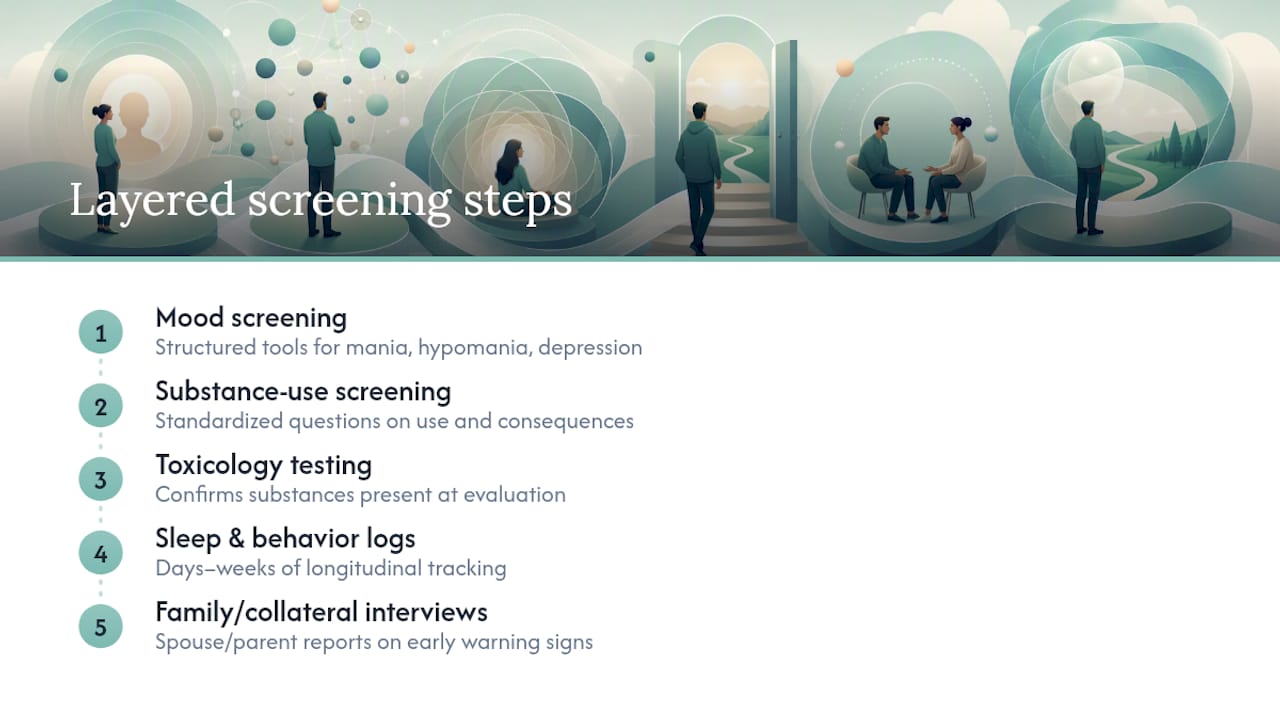
Family and collateral interviews round out the screening process. A spouse, parent, or close friend who has watched someone’s patterns over months often provides observations neither a screening questionnaire nor the person themselves can offer in the moment, particularly around early warning signs that preceded past episodes.
Why Do People With Dual Diagnosis Struggle to Stay in Treatment?
Treatment engagement for co-occurring bipolar disorder and addiction runs into obstacles that neither disorder alone typically creates. Someone in a hypomanic phase may feel too good to see the need for treatment at all. Someone in a depressive episode may feel too hopeless to believe treatment will help. Both states undercut motivation from opposite directions, often within the same month.
Stigma compounds the problem, and it comes from two directions at once: shame around addiction and shame around a serious mental illness diagnosis, each reinforcing the other and making people reluctant to disclose either one fully to a provider.
Fragmented care systems make things worse structurally. When addiction treatment and psychiatric care operate through separate providers, separate insurance authorizations, and separate paperwork, the sheer logistical burden of coordinating both becomes its own barrier, especially during a period when executive function is already compromised by mood symptoms.
Strategies that measurably improve adherence include same-site integrated care that removes the burden of juggling multiple providers, case management support to handle appointments and insurance logistics, and motivational interviewing approaches that work with a person’s ambivalence rather than demanding immediate buy-in. Family involvement, when boundaries around privacy are set clearly in advance, also correlates with better follow-through, since someone else is tracking appointments and noticing early warning signs alongside the patient.
How Does This Affect Relationships, Work, and Family Life?
Co-occurring bipolar disorder and addiction rarely stay contained to one part of a person’s life. The same instability that shows up in mood episodes and substance use tends to ripple outward into every relationship and responsibility around it.
Occupationally, unpredictable mood episodes combined with substance use often produce a pattern of job instability, missed work during depressive episodes, impulsive decisions or conflicts during manic ones, and impaired performance from active substance use layered on top of both. That instability compounds over time, since each job loss or workplace conflict adds financial stress that itself worsens both conditions.
Socially, relationships absorb the unpredictability directly. Friends and partners often describe feeling like they’re dealing with several different people depending on the week, which erodes trust even when everyone involved understands the diagnosis intellectually. Isolation frequently follows, sometimes from the person withdrawing during depressive episodes, sometimes from friends and family pulling back after repeated crises.
Family functioning takes perhaps the heaviest toll, since the family often carries the caregiving burden during acute episodes while also absorbing the financial and emotional consequences of unstable behavior. Spouses and partners of someone managing bipolar disorder and addiction together frequently describe cycles of hope during stable periods and exhaustion during crises. Consistent treatment, including family programming that gives everyone a shared framework and language, tends to reduce that cycle’s intensity over time, even when it can’t eliminate it entirely.
What Special Considerations Apply to Adolescents, Pregnant Women, and Older Adults?
Adolescents present a genuine diagnostic challenge, since bipolar disorder can be difficult to distinguish from normal teenage mood variability, and substance use in teens frequently gets attributed to typical risk-taking rather than screened as a potential symptom of an underlying mood disorder. Family involvement matters even more at this age, since parents and caregivers typically manage both treatment engagement and daily monitoring for a minor.
Pregnant women face a particularly delicate medication balance. Several mood stabilizers carry documented risks during pregnancy, so psychiatric medication management requires close coordination between a psychiatrist and an obstetric provider, not a decision made in isolation by either one. Untreated bipolar disorder during pregnancy carries its own real risks, which makes abruptly stopping medication without medical guidance just as dangerous as continuing it without oversight, and the same caution applies to any withdrawal from substances during pregnancy, which should happen only under direct medical supervision given the risks to both mother and fetus.
Older adults often deal with co-occurring bipolar disorder and addiction alongside other medical conditions and medications, which raises the risk of drug interactions substantially. Cognitive changes that come with aging can also complicate accurate self-report during screening, making collateral information from family even more valuable than it is in younger patients. Isolation, a common experience in older age generally, can also mask both worsening mood symptoms and escalating substance use for longer before anyone intervenes.
What Is the Long-Term Outlook for Bipolar Disorder and Addiction?
Long-term outcomes for co-occurring bipolar disorder and addiction are not uniformly grim, but they are realistic in a way that deserves honest framing rather than easy reassurance. The clinical literature on co-occurring disorders is clear that this comorbidity is associated with worse outcomes than bipolar disorder alone, including more frequent hospitalization and higher suicide risk, and no single treatment reliably resolves both conditions for every patient.
That said, integrated treatment measurably improves the odds of durable recovery compared with treating either condition in isolation. People who engage consistently with coordinated psychiatric and addiction care, who build the daily monitoring habits described earlier, and who maintain family or peer support systems tend to see longer periods of stability between episodes and less severe episodes when they do occur.
Recovery from this combination is rarely a straight line. Mood stability can take months to establish even with the right medication regimen, and relapse in either domain, mood or substance use, does not erase prior progress. It is a signal to adjust the treatment plan, not evidence that treatment has failed. The most consistent predictor of a better long-term course is not the absence of setbacks. It is staying connected to coordinated care through them.
An Honest Perspective on Treating Bipolar Disorder and Addiction
Stabilization is rarely a one-time event, and anyone who tells you otherwise is selling something. The realistic picture for co-occurring bipolar disorder and addiction involves ongoing management, occasional setbacks, and a treatment relationship that continues well past the point where symptoms first settle down. Relapse, whether it’s a mood episode or a return to substance use, does not mean the work has failed. It usually means the plan needs adjusting, not abandoning.
What consistently gets underestimated is how much the two conditions depend on the same daily infrastructure: sleep, routine, medication adherence, and honest tracking of small changes before they become large ones. Clinical treatment matters enormously, but it works best layered with peer support and family involvement, not as a replacement for either. The people who do best long-term tend to be the ones who built a support structure wider than a single prescriber or a single treatment stay.
If you take one thing from this article, take this: getting assessed for both conditions, even if you’re only sure about one, is worth doing sooner rather than later.
— Jim
Getting Help From Connected Recovery for Bipolar and Addiction
Reading about integrated treatment is one thing. Getting it is another, and that gap is exactly what some specialized treatment centers exist to close. Instead of piecing together a psychiatrist here and an addiction counselor there, hoping the two eventually compare notes, some centers keep mood and substance use treatment under one coordinated roof, often in small boutique settings to enhance staff attention.

The continuum runs from medical detox for safe, supervised withdrawal, into residential treatment for mood stabilization and therapy, with dual diagnosis treatment addressing bipolar disorder and substance use concurrently rather than in sequence. For opioid use disorder specifically, medication-assisted treatment is coordinated directly with psychiatric medication management, not managed as a separate track. Aftercare planning starts well before discharge, so there’s a concrete next step waiting instead of a gap.
Intake starts with a clinical assessment covering both your mental health and substance use history, followed by a conversation about insurance or private-pay options. If you’re trying to figure out whether this is the right level of care for yourself or someone you love, call Connected Recovery to talk through your situation with a clinical team that treats bipolar disorder and addiction as one connected problem, not two separate ones.
Sources
- SAMHSA — National Survey on Drug Use and Health (NSDUH) 2024 summary
- NIMH — Bipolar disorder overview
- SAMHSA — Co-occurring disorders: integrated treatment guidance (PEP)
- 2024 review of randomized trials (Healio)
- NCBI Bookshelf — Substance use disorder treatment for people with co-occurring disorders (Chapter 4)
This article is general information, not a substitute for advice from a qualified doctor. Consult a qualified healthcare professional about your own circumstances before acting on anything here.
FAQ
Are People With Bipolar Disorder More Prone to Addiction?
Yes. Clinical literature consistently describes bipolar disorder and substance use disorders as co-occurring far more often than chance would predict, driven by self-medication during mood episodes, impulsivity during mania, and shared neurobiological vulnerability. The NCBI clinical resource on co-occurring disorders treats this overlap as the clinical norm rather than an unusual exception.
What Is the Life Expectancy for Someone With Bipolar Disorder?
Life expectancy varies widely based on treatment engagement, co-occurring conditions, and access to care, and no single reliable figure applies to everyone. What is well established is that untreated bipolar disorder, particularly combined with an untreated substance use disorder, carries measurably higher risks of hospitalization and suicide, which is precisely why integrated treatment and consistent follow-up care matter so much for long-term health.
What Mental Illness Is Most Commonly Linked to Addiction?
Several conditions show strong overlap with addiction, and bipolar disorder is consistently among the most frequently cited, alongside major depressive disorder, anxiety disorders, and PTSD. The connection often runs through shared mechanisms like self-medication and impulsivity, which is why clinicians are trained to screen for a mental health condition whenever someone presents with a substance use disorder, and vice versa.
What Are the Signs a Family Member Might Have Both Conditions?
Watch for patterns rather than isolated incidents: periods of racing thoughts, reduced sleep, or grandiosity that coincide with heavier substance use, followed by depressive stretches involving withdrawal or increased use of a different kind. A written log of sleep, mood, and substance use over several weeks, and an honest conversation with a psychiatric provider experienced in dual diagnosis, gives far more clarity than trying to interpret a single difficult episode in isolation.
How Is Bipolar Disorder and Addiction Treated Together?
The recommended approach is integrated treatment, meaning both conditions are addressed concurrently by a coordinated clinical team rather than one after the other. That typically combines mood-stabilizing medication, evidence-based addiction medications where appropriate, psychotherapy such as CBT or interpersonal and social rhythm therapy, and structured aftercare, which is the model programs like Connected Recovery’s dual diagnosis treatment are built around.
Recommended
DHCS Licensed · Joint Commission Accredited
If you or a loved one is struggling with substance use, our admissions team is available to verify your insurance benefits and help you begin recovery. All calls are confidential.