
How Addiction Develops Over Time: A Clinical Timeline

Addiction is a chronic, relapsing brain disorder moving from voluntary use to compulsive seeking through predictable neurobiological and behavioral stages. The progression is not random. Three interlocking forces drive it: neuroadaptations in the brain’s reward, stress, and executive-control circuits; a behavioral shift from pleasure-seeking to relief-seeking; and individual risk factors including genetics, developmental timing, and co-occurring psychiatric illness. Understanding how these forces interact over months and years is what separates effective clinical intervention from guesswork.
Data from the National Epidemiologic Survey on Alcohol and Related Conditions (NESARC) show that half of transitions from alcohol abuse to dependence occurred within about 3.16 years, while cocaine moved faster at 1.42 years. The three-stage neurobiological model described by NIDA and NCBI provides the mechanistic framework for why those timelines look the way they do. The sections below unpack that model, the substance-specific data, the developmental vulnerabilities, and what all of it means for treatment.
Table of Contents
- How addiction develops over time: the three-stage neurobiological model
- How fast does dependence actually develop? Timelines by substance
- Why adolescence and other risk factors accelerate the progression
- How behavior shifts as addiction progresses
- What clinical signs look like at each stage of progression
- Why the brain stays changed long after use stops
- How the progression model shapes treatment decisions
- How Connected Recovery addresses the neurobehavioral progression
- Key Takeaways
- What the clinical evidence means for the people living it
- Useful sources and further reading
How addiction develops over time: the three-stage neurobiological model
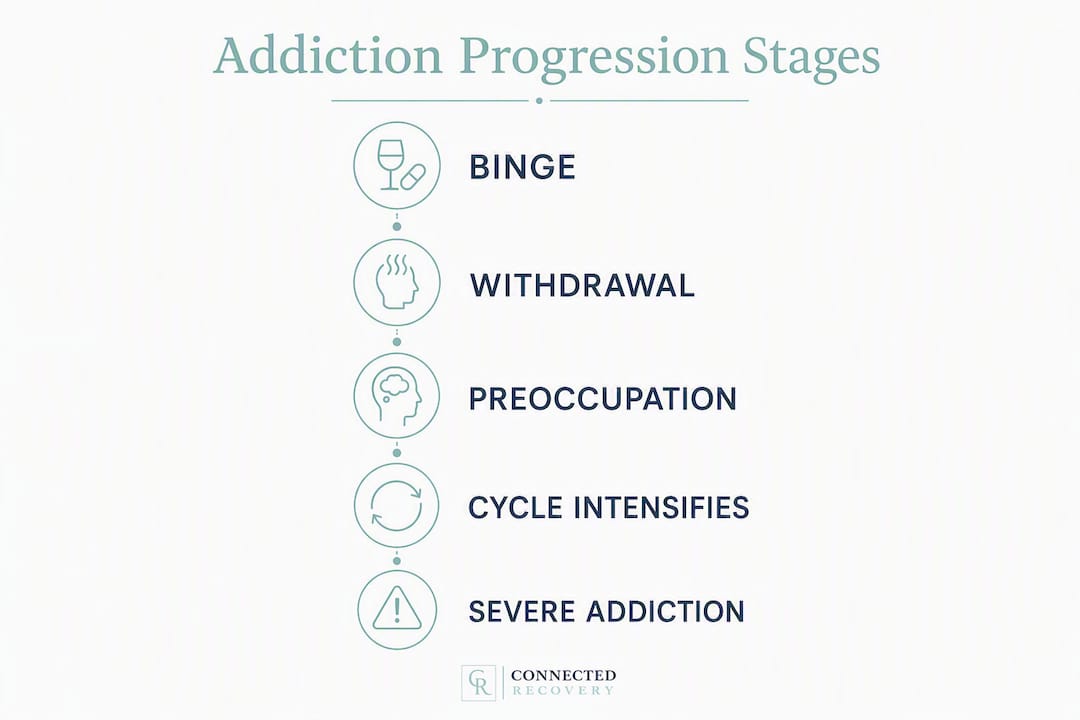
The most clinically useful framework for understanding addiction progression comes from a three-stage cycle: binge/intoxication, withdrawal/negative affect, and preoccupation/anticipation. Each stage maps to a distinct brain region and a distinct set of neuroadaptations.
Stage 1: Binge/intoxication. The basal ganglia, particularly the nucleus accumbens and its dopaminergic inputs from the ventral tegmental area, drive the initial reward signal. Early drug use floods this circuit with dopamine, producing the euphoria that makes substances feel worth repeating. Over time, the brain compensates by downregulating dopamine receptors, so the same dose produces less reward. This is tolerance at the cellular level.

Stage 2: Withdrawal/negative affect. As the reward signal weakens, the extended amygdala takes over. Stress peptides, specifically corticotropin-releasing factor (CRF) and dynorphin, are recruited to fill the gap. The result is dysphoria, anxiety, and irritability during abstinence. The person is no longer using to feel good; they are using to stop feeling bad. Neuroadaptations at this stage include elevated ΔFosB in the nucleus accumbens, increased cAMP/PKA signaling, and glutamate/GABA imbalance, all of which consolidate compulsive behavior at the molecular level.
Stage 3: Preoccupation/anticipation. The prefrontal cortex (PFC), which normally exerts top-down control over impulses and evaluates long-term consequences, becomes progressively impaired. Decision-making shifts toward short-term relief. Cue-induced craving, the kind triggered by a smell, a location, or a person, becomes the dominant driver of use. This is the “craving” stage, and it can persist long after the substance is gone.
Each cycle through these three stages tends to intensify the next. In severe cases, the intoxication-withdrawal-preoccupation cycle can compress into hours; in early-stage use, the cycle may span weeks or months. The direction, though, is consistent: each pass deepens the neuroadaptations and narrows behavioral flexibility.
How fast does dependence actually develop? Timelines by substance
Population-level data give a clearer picture of realistic progression timelines than clinical intuition alone. The NESARC study, one of the largest epidemiologic surveys of substance use in the United States, tracked transitions from abuse to dependence across substances.
| Substance | Median years to dependence | Lifetime cumulative probability of transition |
|---|---|---|
| Cocaine | 1.42 | 15.6% |
| Cannabis | 1.83 | 9.4% |
| Alcohol | 3.16 | 26.6% |
| Opioids | Variable (often faster with prescription misuse) | Not available from NESARC |
| Nicotine | Rapid (weeks to months in adolescents) | Not available from NESARC |
Source: NESARC, PMC3755735
Cocaine’s relatively short timeline reflects its pharmacokinetics: a fast onset, a short half-life, and a steep crash that immediately recruits negative reinforcement. Cannabis does not pose the same risk for everyone; most people who use it do not meet dependence criteria over a lifetime, though some progress relatively quickly. Alcohol use disorder is common and often underestimated in its early stages, with a comparatively higher likelihood of dependence developing over a longer timeline.
For opioids, particularly prescription opioids and heroin, clinical data consistently show rapid progression, especially with high-potency synthetic opioids like fentanyl. The route of administration matters: intravenous or smoked delivery accelerates the onset of neuroadaptation compared to oral dosing. Nicotine dependence can develop within weeks in adolescent users, a pattern that reflects both the drug’s pharmacology and the developmental sensitivity of the adolescent brain.
The cumulative probability figures carry an important clinical implication: not everyone who abuses a substance will develop dependence. But the subset who do progress tends to do so within a predictable window, which is exactly when early intervention has the most leverage.
Why adolescence and other risk factors accelerate the progression
The prefrontal cortex does not fully mature until the mid-twenties. During adolescence, the reward circuitry is highly active while the executive-control circuitry is still under construction. That imbalance means adolescents are neurobiologically primed to weight immediate reward heavily and discount future consequences. Early initiation of drug use during this period increases the risk of developing a substance use disorder precisely because substances interact with active synaptic pruning and myelination processes, altering the trajectory of brain development itself.
Genetics account for roughly 40–60% of addiction risk, but that heritability does not operate in isolation. Gene-environment interactions are the rule, not the exception. A person with a family history of alcohol use disorder who also grows up in a high-stress environment with easy substance access faces compounding risk that neither factor alone would predict.
The major modifiable and unmodifiable risk factors include:
- Family history and genetics: Heritability of 40–60% across substance use disorders; specific gene variants affect dopamine signaling and stress reactivity.
- Age at first use: Earlier initiation consistently predicts faster progression and higher lifetime severity.
- Early-life trauma and adverse childhood experiences (ACEs): Trauma dysregulates the stress-response system, increasing vulnerability to the negative-reinforcement trap.
- Co-occurring psychiatric disorders: Depression, PTSD, ADHD, and anxiety disorders each accelerate progression and complicate treatment; environmental risk factors including stress exposure and poor parenting interact with these vulnerabilities.
- Polysubstance use: Using multiple substances simultaneously or sequentially recruits overlapping neural circuits and shortens the timeline to severe dependence.
- Social and environmental factors: Peer substance use, low socioeconomic status, parental substance use, and high drug availability all increase exposure and reduce protective buffering.
- Route of administration: Smoked or injected substances reach peak brain concentration faster, accelerating neuroadaptation.
Epigenetic changes, modifications to gene expression that do not alter the DNA sequence itself, are one mechanism through which early adversity and early substance exposure leave lasting marks on the brain’s stress and reward systems. These changes can persist into adulthood and may even influence offspring, which is one reason why addiction tends to cluster in families across generations even when the shared environment is controlled for.
Pro Tip: For clinicians and families, validated screening tools like the CRAFFT (for adolescents) or AUDIT-C (for alcohol) can identify risk before dependence criteria are met. Brief motivational interventions at this stage, before the behavioral shift to negative reinforcement, carry the strongest evidence for altering the trajectory.
How behavior shifts as addiction progresses
The behavioral signature of early-stage use is impulsivity: a person takes a drug because it feels good and the immediate reward outweighs perceived risk. That is positive reinforcement, and it is the same mechanism that drives most learned behavior. What makes addiction different is what happens next.

As neuroadaptations accumulate, the reward system becomes less responsive to the drug and to natural rewards alike. The person no longer uses to feel euphoric; they use to feel normal, or to avoid the dysphoria, anxiety, and physical discomfort of withdrawal. This shift from positive to negative reinforcement marks the transition from experimental use to chronic compulsive use. It is also the point at which behavioral flexibility collapses. Choices that once seemed obvious, maintaining relationships, showing up to work, avoiding legal risk, start to lose their weight against the immediate imperative of relief.
The impulsivity-to-compulsivity shift is visible in clinical presentation. Early-stage patients often retain insight and can articulate ambivalence about their use. Later-stage patients frequently minimize, rationalize, or deny the severity, not because they are dishonest, but because the PFC impairment that drives compulsive use also impairs accurate self-assessment. This has direct implications for treatment: motivational interviewing works well early, when ambivalence is accessible; later stages typically require more structured behavioral interventions, medication support, and a higher level of care.
The cycle’s time scale also shifts. In severe addiction, the intoxication-withdrawal-preoccupation cycle can compress into hours, meaning the person is essentially always in one of the three stages simultaneously. That compression is what makes outpatient management inadequate for many people at the severe end of the spectrum.
What clinical signs look like at each stage of progression
Recognizing stage-appropriate signs is what allows clinicians and families to match the urgency of their response to the actual severity of the problem.
Early use (experimentation to regular use):
- Increased secrecy or changes in social circle
- Mood shifts tied to use or non-use
- Declining interest in previous activities
- Minimizing or joking about frequency of use
Escalating use (abuse, pre-dependence):
- Tolerance: needing more to achieve the same effect
- Using in situations where it is clearly risky (driving, work)
- Continued use despite visible negative consequences
- Failed attempts to cut down
- Preoccupation with obtaining or using the substance
Dependence and severe disorder:
- Physical withdrawal symptoms on cessation (tremors, sweating, nausea, seizure risk with alcohol/benzodiazepines)
- Complete reorganization of daily life around the substance
- Significant occupational, legal, or relationship consequences
- Cognitive impairment: poor concentration, memory gaps, impaired judgment
- Co-occurring psychiatric symptoms: depression, anxiety, paranoia, or psychosis depending on the substance
Co-occurring psychiatric disorders modify this picture in important ways. Depressive symptoms can mask substance-driven mood changes, and anxiety disorders can be mistaken for stimulant withdrawal or cannabis-induced anxiety. The clinical rule is to assess both simultaneously rather than waiting to see which resolves first.
Signs that indicate the need for medical detox or urgent inpatient evaluation include alcohol or benzodiazepine withdrawal (seizure and delirium risk), opioid withdrawal with medical complications, suicidal ideation, severe psychiatric decompensation, or any presentation where the person cannot safely manage their own care. These are not situations where outpatient management is appropriate as a first step.
Why the brain stays changed long after use stops
Stopping drug use does not immediately reverse the neuroadaptations that built up over months or years. Elevated ΔFosB in the nucleus accumbens, altered dopaminergic tone, neuroinflammatory changes, and PFC dysfunction can persist well into abstinence. Neuroinflammation, specifically microglial and astrocyte activation, is increasingly recognized as a contributor to protracted cognitive and emotional dysfunction after cessation, which helps explain why some people feel cognitively impaired or emotionally flat for months after stopping.
The concept of incentive salience is central to understanding cue-induced relapse. Through repeated pairings of drug use with specific cues (people, places, emotions, sensory triggers), those cues acquire the ability to activate the wanting system independently of any conscious decision. A person who has been abstinent for two years can walk past a bar where they used to drink and experience a craving that feels physiologically identical to what they felt during active use. The brain has not forgotten; it has encoded the association at a level that is not accessible to willpower alone.
Aftercare and relapse-prevention planning are clinically necessary, not optional add-ons. The research on recovery as a lifelong process consistently shows that sustained engagement with support structures, whether peer-based, therapeutic, or pharmacological, significantly reduces relapse frequency and severity over time. Structured relapse prevention programs that specifically target cue reactivity, cognitive distortions, and social triggers address the neurobiological reality of prolonged vulnerability rather than assuming that detox alone is sufficient.
How the progression model shapes treatment decisions
The three-stage model is not just descriptive. It directly informs what kind of treatment is appropriate at each point in the progression.
Early engagement and brief intervention. For people in the early-use or escalating-use phase, brief motivational interventions and psychoeducation can shift the trajectory before dependence is established. This is the highest-leverage point in the entire progression.
Acute medical stabilization and detox. The withdrawal/negative affect stage often requires medically supervised management, particularly for alcohol, benzodiazepines, and opioids. Medical detox addresses the physiological component of withdrawal safely, manages seizure and delirium risk, and creates the biological stability needed for the next phase of treatment. Detox alone is not treatment; it is the entry point.
Medication-assisted treatment (MAT). For opioid and alcohol use disorders, MAT is among the most evidence-supported interventions available. Buprenorphine and methadone reduce opioid craving and withdrawal; naltrexone blocks opioid and alcohol reward; acamprosate reduces alcohol craving. These medications work by directly targeting the neuroadaptations driving negative reinforcement and craving.
Psychosocial therapies. Cognitive behavioral therapy (CBT) addresses the PFC-level distortions that sustain compulsive use. Contingency management uses structured positive reinforcement to rebuild the reward system’s responsiveness to non-drug rewards. Dialectical behavior therapy (DBT) is particularly useful when emotional dysregulation and trauma are prominent. These are not interchangeable; matching the therapy to the patient’s stage and co-occurring conditions matters.
Integrated dual-diagnosis care. The MSD Manual and clinical practice guidelines consistently recommend treating co-occurring psychiatric disorders concurrently rather than sequentially. Treating depression or PTSD after addiction, or vice versa, produces worse outcomes than addressing both simultaneously. Dual-diagnosis treatment is the standard of care for anyone presenting with both a substance use disorder and a psychiatric condition.
Aftercare planning. Given the persistence of neuroadaptations and cue-induced relapse risk, discharge without a structured aftercare plan is a clinical gap. Aftercare planning should include ongoing therapy, peer support, medication continuation where indicated, and a clear protocol for what to do if relapse occurs.
A practical escalation sequence for clinicians and families:
- Screen and assess: Use validated tools (AUDIT, DAST-10, CRAFFT) to establish severity and identify co-occurring conditions.
- Medical stabilization: If withdrawal risk is present, arrange medically supervised detox before any other intervention.
- Level of care determination: Use ASAM criteria to match the patient to the appropriate intensity (outpatient, intensive outpatient, residential, or medically managed inpatient).
- Integrated treatment: Combine MAT where indicated with evidence-based psychosocial therapies and psychiatric care.
- Aftercare and relapse prevention: Build the plan before discharge, not after.
How Connected Recovery addresses the neurobehavioral progression
Understanding the neurobiology of addiction progression is one thing. Translating it into a treatment program that actually addresses each stage is another.
Connected Recovery operates as a boutique 12-bed residential facility in Van Nuys, Los Angeles, with 24/7 medical supervision and an integrated dual-diagnosis model. The small capacity is a deliberate clinical choice: individualized attention at the level that a 12-bed program can provide is structurally different from what a 60-bed facility can offer. Every treatment plan is tailored to the individual’s stage of addiction, substance history, psychiatric comorbidities, and recovery goals.
Program components map directly to the neurobiological stages described throughout this article:
- Medication-assisted treatment: — Integrated into the residential program for opioid and alcohol use disorders, targeting the neuroadaptations that drive craving and negative reinforcement.
- Relapse prevention: — Specifically targets cue reactivity, cognitive distortions, and the behavioral patterns that sustain the preoccupation/anticipation stage.
- Aftercare planning: — Begins at admission, not at discharge. The goal is a structured, individualized plan that accounts for the persistence of neuroadaptations beyond the residential stay.
For individuals presenting with severe withdrawal risk, polysubstance use, or uncontrolled psychiatric comorbidity, residential care is not a preference; it is the clinically appropriate level of care. Residential treatment provides the environmental containment, medical oversight, and therapeutic intensity that outpatient settings cannot replicate for these presentations.
Pro Tip: Functional approaches to brain recovery, including those described in research on neurodegeneration and functional medicine, are increasingly discussed as adjuncts to standard addiction treatment. While not a replacement for evidence-based care, they reflect growing clinical interest in supporting neuroplasticity during recovery.
Key Takeaways
Addiction progresses through predictable neurobiological stages, and matching treatment intensity to the stage of progression is what determines clinical outcomes.
| Point | Details |
|---|---|
| Three-stage model | Addiction cycles through binge/intoxication, withdrawal/negative affect, and preoccupation/anticipation, each driven by distinct brain circuits. |
| Substance-specific timelines | Median years to dependence range from 1.42 (cocaine) to 3.16 (alcohol); lifetime cumulative probabilities vary from 9.4% (cannabis) to 26.6% (alcohol). |
| Adolescent vulnerability | Early initiation during prefrontal cortex development accelerates progression and raises lifetime severity; genetics account for 40–60% of risk. |
| Relapse is neurobiological | Persistent neuroadaptations including elevated ΔFosB and cue-encoded incentive salience mean relapse risk continues long after cessation and requires structured aftercare. |
| Treatment must match stage | Effective care sequences detox, MAT, integrated psychosocial therapy, and aftercare planning; treating co-occurring psychiatric disorders concurrently is the clinical standard. |
What the clinical evidence means for the people living it
The science of how addiction develops is, at its core, a story about a brain doing exactly what brains are designed to do: adapt to its environment. The problem is that substances exploit that adaptability in ways that progressively narrow a person’s world until the drug is the only thing the reward system reliably responds to.
What gets lost in purely clinical descriptions is that the person inside that process is not weak, broken, or lacking willpower. The neuroadaptations described in this article are not metaphors. They are measurable changes in receptor density, gene expression, and circuit connectivity. Expecting someone to simply decide their way out of a brain that has been structurally reorganized around a substance is not a clinical strategy; it is a misunderstanding of the disorder.
The three-stage model also reframes what recovery actually requires. Detox gets you through the withdrawal stage. Residential treatment addresses the behavioral and psychiatric complexity of the preoccupation/anticipation stage. Aftercare, peer support, and ongoing therapy address the persistence of neuroadaptations that make cue-induced relapse possible years later. None of these phases is optional for someone with moderate to severe addiction; they are sequential necessities.
If you are reading this because you recognize these stages in yourself or someone you care about, the most useful next step is a clinical assessment, not a decision about whether the problem is “bad enough.” The NESARC data show that the window between abuse and dependence is often shorter than people expect. Early assessment does not commit anyone to a particular level of care; it gives you accurate information about where in the progression you actually are.
Connected Recovery’s drug addiction treatment program in Van Nuys starts with exactly that: a thorough assessment that maps the individual’s neurobiological and psychiatric picture before any treatment decisions are made.
This article provides general clinical and educational information about addiction neurobiology and progression. It is not a substitute for professional medical or psychiatric evaluation. If you or someone you know is experiencing a medical emergency related to substance use, contact emergency services immediately.
Useful sources and further reading
The following primary and peer-reviewed sources informed this article. They are organized by the type of evidence they provide.
Neurobiology and the three-stage model:
- Neurobiology of Substance Use, Misuse, and Addiction (NCBI Bookshelf) — foundational clinical definition and three-stage neurocircuit model.
- Neurobiology of addiction: a neurocircuitry analysis (PMC) — detailed circuit-level analysis including the positive-to-negative reinforcement shift and relapse framing.
Population-level timelines:
- Probability and Predictors of Transition from Abuse to Dependence on Alcohol, Cannabis, and Cocaine: Results from NESARC (PMC) — the primary source for substance-specific median timelines and cumulative probabilities cited in this article.
Risk factors, development, and treatment:
- Drug Misuse and Addiction (NIDA) — clinical summary of risk factors, heritability estimates, and treatment principles.
“The transition to addiction results from a sequential interaction between individual vulnerability and degree of drug exposure — a process that unfolds over time and is shaped by both biology and environment.” — A multistep general theory of transition to addiction, PMC3767888
Recommended
DHCS Licensed · Joint Commission Accredited
If you or a loved one is struggling with substance use, our admissions team is available to verify your insurance benefits and help you begin recovery. All calls are confidential.