
How to Track Progress During Detox Effectively

Tracking progress during detox is the process of systematically observing your physical, mental, and emotional changes to confirm steady recovery and catch complications early. Medical detox is a structured clinical intervention that requires ongoing monitoring well beyond willpower alone. Without a clear record of where you started and how you are changing, it is nearly impossible to tell whether withdrawal symptoms are easing or worsening. Detox progress tracking gives you that record, and it gives your care team the data they need to act fast when something shifts.
How to track progress during detox: the core method
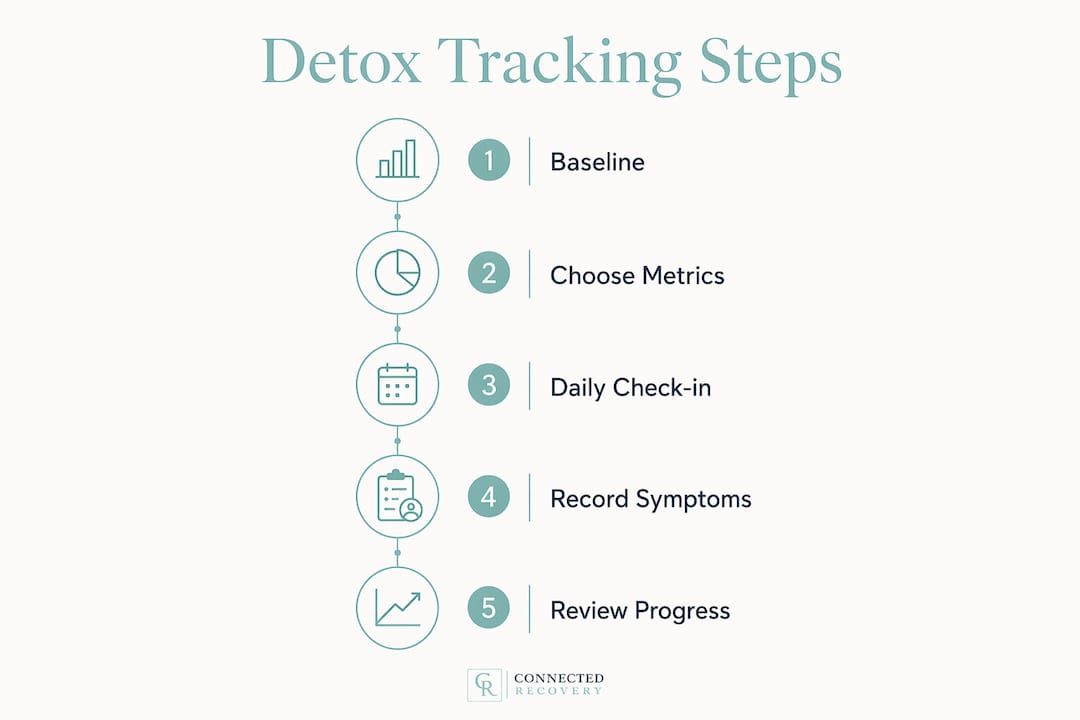
The most effective detox progress tracking starts before detox begins. Establishing a baseline by documenting your mood, sleep quality, and energy for a few days before changing your behavior creates a reference point for every measurement that follows. Without that starting line, a score of “6 out of 10 for energy” means nothing. With it, the same score tells you exactly how far you have come.
Choose three to four key metrics and stick with them. The most useful detox progress indicators are:
- Mood: Rate your overall emotional state on a 1–10 scale each morning.
- Sleep quality: Note how many hours you slept and whether you woke up feeling rested.
- Energy level: Score your physical energy at midday on a 1–10 scale.
- Craving frequency: Record how many strong cravings you experienced in the past 24 hours.
Simple scoring systems outperform detailed journals during detox. Low-friction tracking using yes/no checkboxes or 1–10 scales is more sustainable than writing paragraphs when you are already physically and mentally taxed. The goal is consistent data, not literary output.
Pro Tip: Track fewer metrics, not more. Choosing mood, sleep, and craving frequency as your three core measures reduces cognitive load and keeps you consistent through the hardest days.

Seven days is the most commonly reported sweet spot for tracking detox progress, long enough to see real improvements in focus, sleep, and motivation without demanding an overwhelming commitment. That one week of data often reveals patterns that feel invisible day to day.
What does a daily detox check-in routine look like?
A daily check-in routine works best when it happens at the same time every day. Consistency trains your brain to treat monitoring as a habit rather than a chore. Most people find a morning check-in and a brief evening review covers the full picture.
A practical daily routine looks like this:
- Morning (within 30 minutes of waking): Rate your sleep quality from the night before, note your mood, and record your energy level. Write down any physical symptoms such as headaches, nausea, or muscle tension.
- Midday: Check your hydration. Note your appetite and whether you ate a full meal. Record any cravings that appeared before noon.
- Evening (30 minutes before bed): Review your craving frequency for the day. Note your digestive function and any changes in mental clarity. Score your overall emotional balance for the day.
Logging metrics morning and evening identifies both positive changes and warning signs far faster than a single daily entry. Two data points per day create a trend line. One data point per day creates a list.
Obstacles to consistency are predictable. Fatigue, low motivation, and bad symptom days are the most common reasons people skip their check-in. The fix is to reduce the effort required. Keep your tracking tool, whether a notebook or a phone app, in a visible spot. Set a phone reminder. Make the entry take under two minutes.
Pro Tip: Pair your check-in with an existing habit like brushing your teeth or making coffee. Attaching a new behavior to an established one dramatically improves follow-through.
Physical signs deserve as much attention as emotional ones. Hydration, appetite, sleep hours, and energy are the four physical pillars of a solid detox daily check-in. Tracking all four gives you a complete picture of how your body is responding.
What are the warning signs and positive indicators to watch for?
Positive detox progress indicators are real and measurable. As withdrawal eases, most people notice steadier mood, longer uninterrupted sleep, reduced craving intensity, and clearer thinking. These improvements rarely arrive all at once, but they do arrive.
The warning signs that require immediate medical attention are distinct from normal withdrawal discomfort. Vital signs monitoring during medical detox specifically watches for dangerous shifts in blood pressure, pulse, and temperature, as well as mental status changes like confusion or hallucinations. These are not symptoms to wait out at home.
Progress during detox is almost never a straight line upward. A difficult Tuesday after a better Monday is not failure. It is a normal part of withdrawal. What matters is the overall trajectory across seven to fourteen days, not what any single day looks like.
Non-linear recovery patterns are the norm, not the exception. Tracking helps you distinguish a rough patch from a genuine complication. When your log shows three bad days in a row with worsening physical symptoms, that is a signal to contact your care team. When it shows one hard day surrounded by better ones, that is a normal fluctuation.
Seek professional help immediately if you experience rapid escalation of any symptom, severe confusion, seizures, or hallucinations. These are medical emergencies, not detox milestones. A residential detox program provides 24/7 clinical oversight precisely because these events can occur without warning.
What tools and methods work best for detox progress tracking?
The right tracking tool is the one you will actually use every day. Three main options cover most situations.
| Method | Ease of use | Cost | Data visualization |
|---|---|---|---|
| Paper journal or notebook | High | Low | None (manual review) |
| Habit tracker app | Medium | Free to low | Charts and trend graphs |
| Clinical monitoring chart | High (with support) | Covered in treatment | Reviewed by care team |
A paper journal works well for people who find screens distracting during recovery. A habit tracker app provides automatic trend graphs, which makes it easier to see progress across a week. Health apps that log mood, sleep, and physical changes provide tangible visual proof of progress over time. That visual proof is a powerful motivator on hard days.
Clinical monitoring goes beyond self-reporting. Professional clinical monitoring combines physical vital checks with cognitive status assessments to identify emergent complications quickly. Self-tracking and clinical monitoring are not competing methods. They work together. Your daily log gives your care team context. Their assessments give your log clinical meaning.
Photos and physical measurements add another layer for people tracking body changes alongside withdrawal symptoms. A weekly photo or a simple weight log creates visual evidence of physical recovery that numbers alone sometimes miss.
Pro Tip: Choose the tool with the least friction for your current state. If you are exhausted and symptomatic, a five-question phone app beats a blank journal page every time.
Key Takeaways
Consistent, low-friction detox progress tracking is the single most effective way to stay safe, stay motivated, and give your care team the data they need to support your recovery.
| Point | Details |
|---|---|
| Start with a baseline | Document mood, sleep, and energy before detox begins to create a meaningful comparison point. |
| Track 3–4 core metrics | Mood, sleep quality, energy, and craving frequency cover the full picture without causing burnout. |
| Check in twice daily | Morning and evening entries catch both positive shifts and warning signs faster than one daily note. |
| Expect non-linear progress | A hard day after a good one is normal. Focus on the seven-day trend, not individual days. |
| Know the red flags | Confusion, hallucinations, or rapidly worsening symptoms require immediate medical attention. |
What I have learned from watching people track their detox progress
People come into detox expecting a clear arc: bad at first, then steadily better. That expectation sets them up for panic when day four is harder than day two. The most useful shift I have seen is when someone stops treating their tracking log as a report card and starts treating it as a weather log. Weather is not good or bad. It just is. Your job is to record it accurately.
The individualized treatment approach matters here more than most people realize. Two people detoxing from the same substance will have different baselines, different symptom timelines, and different warning signs. Generic tracking templates help, but they work best when adapted to your specific history and physiology.
The other thing I have seen derail tracking is perfectionism. Someone misses one evening check-in and decides the whole system is broken. It is not. A gap in your log is just a gap. Pick up the next morning and keep going. The value of tracking comes from the pattern across days and weeks, not from a perfect record.
Tracking also does something subtle that most people do not anticipate. It shifts your attention from “when will this be over” to “what is actually changing.” That shift reduces anxiety. When you can look at your log and see that your sleep score went from a 3 to a 6 over ten days, the process feels real and finite. That matters enormously when you are in the middle of it.
— Jim
Connected Recovery’s approach to monitoring your detox
Connected Recovery operates a 12-bed facility in Van Nuys, CA, built specifically for people who need close, personalized attention during detox and residential treatment. The small size is intentional. Every person in the program receives 24/7 medical supervision, which means clinical monitoring of vital signs and mental status runs continuously, not just during scheduled check-ins.
The team at Connected Recovery integrates patient-reported progress tracking with clinical assessments, so your daily observations become part of your medical record. That combination of self-monitoring and professional oversight is what makes medical detox at Connected Recovery different from going it alone. If you are ready to detox with a team that tracks every step alongside you, Connected Recovery’s admissions process is straightforward and confidential.
FAQ
What does it mean to track progress during detox?
Tracking progress during detox means systematically recording physical, mental, and emotional changes throughout withdrawal to confirm recovery is moving forward and to catch complications early.
How many metrics should I track each day?
Three to four metrics, such as mood, sleep quality, energy, and craving frequency, provide enough data to spot trends without creating cognitive overload during an already demanding process.
How long does it take to see real detox progress?
Seven days is the most commonly reported point at which measurable improvements in focus, sleep, and motivation become visible, though individual timelines vary based on substance and health history.
What warning signs should I watch for during detox?
Severe confusion, hallucinations, rapid escalation of physical symptoms, or significant changes in blood pressure and pulse are medical emergencies that require immediate professional attention.
Is self-tracking enough, or do I need clinical monitoring?
Self-tracking and clinical monitoring serve different purposes and work best together. Self-tracking captures daily patterns, while clinical monitoring detects physiological complications that self-reporting alone cannot identify.
Recommended
DHCS Licensed · Joint Commission Accredited
If you or a loved one is struggling with substance use, our admissions team is available to verify your insurance benefits and help you begin recovery. All calls are confidential.