Smoking in Rehab: What U.S. Policies Actually Allow

Rehab smoking rules vary significantly across U.S. programs. Most allow smoking only in supervised, designated outdoor areas, while a growing share have gone fully tobacco-free and pair that policy with clinical support to quit. A 2021 national survey of 16,623 SUD treatment providers found that 67.8% of residential facilities permitted smoking in designated outdoor areas, while 52.1% of outpatient facilities did the same. Fully tobacco-free campuses are less common but increasing, particularly in states with explicit mandates.
The three most common policy types you’ll encounter:
- Tobacco-free grounds: No smoking or vaping anywhere on campus; cessation treatment is typically offered at intake.
- Indoor ban with designated outdoor areas: Smoking is allowed in a specific outdoor spot, usually during scheduled, supervised breaks.
- Permissive programs: Fewer restrictions on when and where clients smoke, though these are becoming rarer.
Vaping and marijuana are handled separately at most programs. Some facilities that allow cigarettes ban e-cigarettes entirely; others treat vaping identically to smoking. Marijuana policies depend heavily on state law and whether the client is in a program that tests for cannabis.
Key Takeaways
Most U.S. rehabs allow smoking in designated outdoor areas, but facilities that treat tobacco clinically with NRT, medication, and counseling produce better outcomes and are more likely to have tobacco-free grounds policies.
| Point | Details |
|---|---|
| Policy variation is the norm | 67.8% of residential facilities permit designated outdoor smoking; only 33.9% ban both smoking and vaping. |
| Quitting during treatment helps | Patients who quit smoking during admission showed mental-health improvements comparable to non-smokers at follow-up. |
| Ask about pharmacotherapy at intake | Facilities commonly offer NRT and some offer non-nicotine medications; request both before arrival, not after. |
| State mandates differ significantly | New York requires 100% tobacco-free grounds for all certified SUD programs; other states only ban indoor smoking. |
| Connected Recovery | Offers individualized tobacco-cessation planning, NRT coordination, and medication management within its residential program. |
Table of Contents
- Why smoking is so common in addiction treatment settings
- What U.S. rehab smoking policies look like in practice
- What research says about quitting tobacco during SUD treatment
- What tobacco-cessation support rehabs typically offer
- Questions to ask a rehab about its smoking policy before you go
- How to prepare as a smoker entering rehab
- Where to check state rules and find free cessation resources
- How treatment teams balance tobacco policy, patient engagement, and clinical care
- Connected Recovery’s approach to tobacco use and residential care
- Sources
Why smoking is so common in addiction treatment settings
People entering SUD treatment smoke at far higher rates than the general population. A clinical inpatient study found 75% of admitted patients were daily smokers at the time of admission. That number alone explains why programs have historically tolerated tobacco rather than treating it as a clinical problem.
Three factors have kept smoking embedded in treatment culture:
- Social bonding: Smoke breaks became a de facto group activity, a rare unstructured moment where clients connect informally.
- Staff behavior: When staff smoke alongside clients, it normalizes tobacco use and complicates any policy shift.
- Clinical lore: A persistent belief held that pushing clients to quit tobacco simultaneously with their primary substance would overload them and increase dropout risk. The research, as discussed below, does not support that fear.
Programs also face a practical tension: requiring tobacco abstinence at admission could deter people from entering treatment at all. Retention is a core metric, and some programs have historically tolerated smoking as a way to keep clients engaged.
What U.S. rehab smoking policies look like in practice
Policy categories map roughly to how much control a program exercises over when and where tobacco use happens.
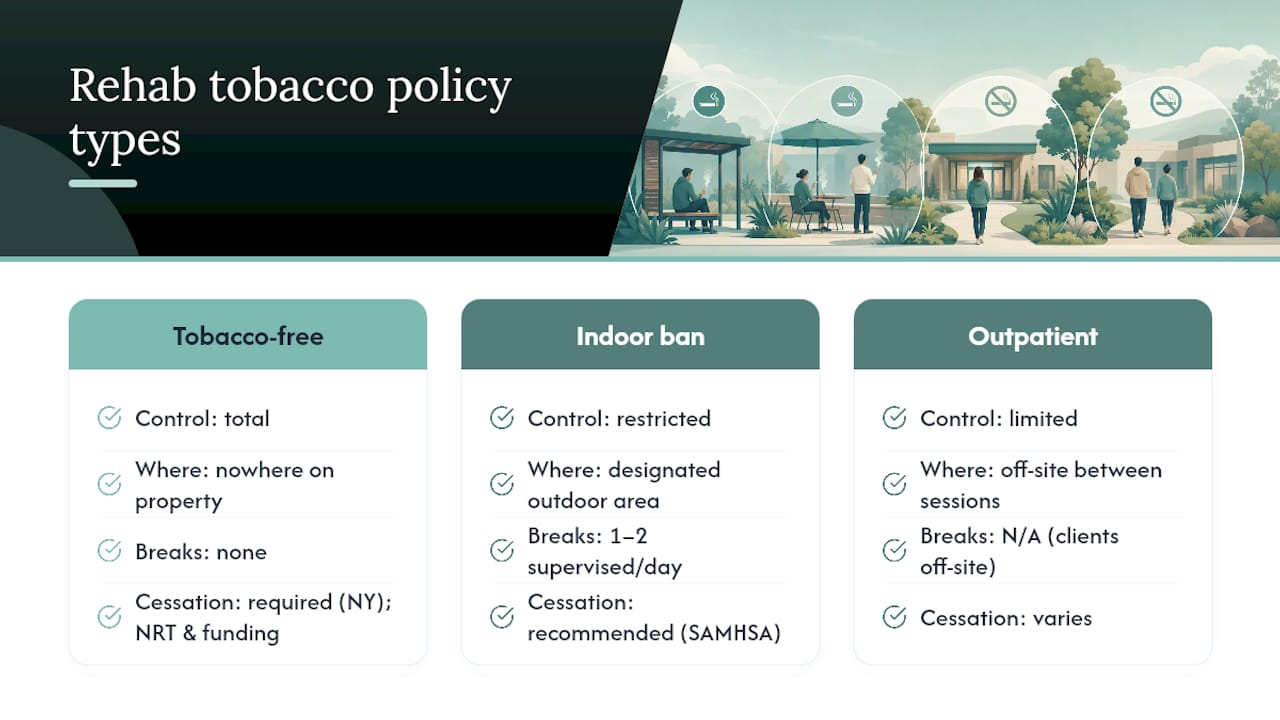
Tobacco-free grounds mean no smoking or vaping anywhere on the property, including parking lots. New York set a clear precedent here: a 2008 OASAS regulation required all state-funded and certified SUD programs to be 100% tobacco-free on program grounds and to provide cessation treatment. That mandate affected approximately 1,419 programs and came with funding, training, and NRT availability built in. Several other states have followed with similar requirements, though the specifics vary.
Indoor bans with designated outdoor areas are the most common model nationally. In residential settings, this usually means one or two supervised outdoor breaks per day in a specific location. Clients typically cannot smoke freely; a staff member is present, and possession rules (how many cigarettes, where they’re stored) are spelled out in the program handbook.
Outpatient programs operate differently because clients leave campus. A client in an intensive outpatient program can technically smoke between sessions. The program’s policy governs only what happens on-site.
The SAMHSA advisory on tobacco-free policy adoption recommends administrators give staff 1–4 months’ notice before a policy takes effect and pair any ban with accessible cessation services. Programs that simply ban smoking without offering treatment tend to see more resistance and enforcement problems.
(2) Are clients allowed to possess cigarettes or vaping devices? (3) How are vaping and marijuana handled? The answers reveal whether you are looking at a clinical tobacco-treatment program or a facility that just manages where people smoke.*
What research says about quitting tobacco during SUD treatment
The short answer: quitting during treatment does not appear to harm recovery from other substances, and for many people it improves outcomes.
The same inpatient study cited above found that patients who quit smoking during their stay showed mental-health and quality-of-life improvements comparable to those who did not smoke at follow-up. That’s a meaningful finding given how often the “don’t rock the boat” argument is used to justify permissive policies.
California’s Tobacco Free for Recovery Initiative produced program-level data showing what happens when policy change is paired with real clinical support. Those reductions happened alongside increases in NRT and pharmacotherapy receipt, which suggests the policy alone wasn’t doing the work — the treatment was.

A CDC analysis of SUD facility data found that 33.9% of facilities reported policies prohibiting both smoking and vaping. That’s still a minority, but it’s grown steadily as evidence has accumulated that tobacco-free policies, when properly supported, don’t drive clients away.
What tobacco-cessation support rehabs typically offer
What that looks like in practice at a well-resourced program:
- Screening at intake: A brief assessment of tobacco use history, readiness to quit, and past quit attempts.
- Counseling: Individual or group sessions using cognitive behavioral therapy (CBT) or motivational interviewing focused on tobacco triggers.
- Nicotine replacement therapy (NRT): Patches, gum, and lozenges are the most common forms. Licensed NRT products increase quit rates by roughly 50%–60% compared to unassisted attempts.
- Prescription medications: Varenicline (Chantix) and bupropion (Wellbutrin/Zyban) are the two FDA-approved non-nicotine options. Both require a prescriber and monitoring.
- Quitline referrals: The national quitline (1-800-QUIT-NOW) and state-specific lines offer free coaching and, in many states, free NRT mailed directly to the caller.
- Behavioral tools: Contingency management and structured coping plans for managing smoking triggers in treatment settings.
Facilities that offer these services are also more likely to have restrictive tobacco policies. The correlation runs both ways: programs that treat tobacco clinically tend to restrict where it can be used, and programs with tobacco-free grounds tend to invest in cessation support.
Pro Tip: At intake, ask specifically: “Can I get a target quit date on my treatment plan and a prescription for NRT or varenicline?” If the answer is vague, ask to speak with the prescribing physician or nurse practitioner directly. Cessation planning should start at admission, not after discharge.
Questions to ask a rehab about its smoking policy before you go
Getting clear answers before admission saves confusion and reduces the chance of a policy conflict derailing early treatment. Ask these directly:
- Is the campus 100% tobacco-free, or are there designated smoking areas?
- Am I allowed to possess cigarettes, vaping devices, or nicotine pouches on campus?
- Are supervised smoke breaks scheduled, and how many per day?
- Are staff permitted to smoke with or near clients?
- Is NRT available on-site, and is it covered under my treatment cost or insurance?
- Can I receive a prescription for varenicline or bupropion during my stay?
- How does the program handle vaping? Is it treated the same as cigarettes?
- What is the policy on marijuana, particularly if I’m in a state where it’s legal?
- Are off-campus trips allowed, and can I purchase tobacco during them?
- What happens if I violate the tobacco policy?
Programs with strong cessation support will answer questions 5 and 6 without hesitation. A program that can’t tell you whether NRT is available is probably not treating tobacco clinically.
How to prepare as a smoker entering rehab
Tell intake staff you smoke before you arrive. That single step opens the door to having NRT or a prescription ready on day one rather than waiting through the intake process while withdrawal sets in.
Practical steps before admission:
- Request NRT in advance: Ask whether the program can arrange a patch or gum prescription before your arrival date so it’s waiting at check-in.
- Know your withdrawal timeline: Nicotine withdrawal peaks within 24–72 hours and typically eases significantly by day 4–7. Understanding what to expect physically reduces the anxiety around those first days.
- Document past quit attempts: Write down what you’ve tried (cold turkey, patch, gum, medication), how long you lasted, and why it didn’t hold. This speeds clinical decision-making on arrival.
- Bring insurance and prescriber information: If you’re already on bupropion for depression, your treatment team needs to know before prescribing it as a cessation aid.
- Plan hand-to-mouth substitutes: Toothpicks, sugar-free gum, and behavioral replacements for the smoking ritual reduce the physical habit loop even when NRT handles the chemical craving.
Pro Tip: Write a one-page summary of your smoking history (cigarettes per day, years smoking, previous quit attempts, medications tried) and bring it to intake. Clinical staff can use it immediately rather than reconstructing it from memory during a stressful admission process.
Where to check state rules and find free cessation resources
State rules on tobacco in SUD facilities are set by licensing and certification bodies, not just public health departments. To find what applies in your state:
- Search your state’s behavioral health or substance use licensing agency website (e.g., New York OASAS, California DHCS, Texas HHSC) for “tobacco-free” or “smoke-free” facility requirements.
- Check whether your state has adopted tobacco-free grounds mandates for licensed SUD programs, or only indoor smoking bans.
- Contact the state agency directly if the website is unclear — licensing staff can confirm what certified programs are required to do.
Free national cessation resources:
- 1-800-QUIT-NOW: The national quitline, available in all 50 states, with free coaching and NRT mailing in many states.
- Smokefree.gov: Text-based support (SmokefreeTXT), a mobile app, and a Spanish-language line (1-855-DÉJELO-YA).
- CDC tobacco resources: Policy guidance and state-by-state data on cessation coverage.
On insurance: ask the program’s admissions coordinator whether NRT and cessation medications are bundled into the residential treatment cost or billed separately. Many commercial insurance plans and Medicaid cover FDA-approved cessation aids, but coverage varies by state and plan.
How treatment teams balance tobacco policy, patient engagement, and clinical care
Residential programs face a real operational tension. A strict tobacco-free policy is clinically defensible and increasingly evidence-supported, but rolling it out without preparation can spike early dropout and staff resistance. The SAMHSA framework treats tobacco-free adoption as a change-management initiative, not a simple rule change. That means communication campaigns, staff training, enforcement protocols, and clinical support all need to be in place before the effective date.

Outpatient programs have less control over client behavior off-site, so their tobacco policies tend to focus on what happens during sessions. Opioid treatment programs (OTPs) operate under additional federal regulations and often have distinct approaches to tobacco, particularly when clients are on methadone or buprenorphine and managing multiple withdrawal processes simultaneously.
The programs that navigate this best tend to share a few traits: they train clinical staff to deliver brief cessation interventions, they make NRT available without requiring a separate appointment, and they frame tobacco treatment as part of recovery rather than an add-on. Client resistance is real — some people entering treatment see smoking as the one coping tool they’re allowed to keep. Clear messaging that cessation support is available, not mandatory, tends to reduce that friction without abandoning the clinical goal.
Connected Recovery’s approach to tobacco use and residential care
Connected Recovery’s residential treatment program in Van Nuys, CA operates with 24/7 medical supervision in a 12-bed setting, which means tobacco use and cessation planning get individualized attention from day one. At intake, clinical staff screen for tobacco use history, assess readiness to quit, and can coordinate NRT or prescription medication management as part of the overall treatment plan.

For clients managing co-occurring mental health conditions alongside SUD, the dual diagnosis program integrates tobacco-cessation planning with psychiatric care, which matters when medications like bupropion serve dual purposes. Discharge planning at Connected Recovery includes continuity of cessation supports so clients aren’t left without a prescription or a quit plan on the day they leave.
To ask specifically about tobacco policy, NRT availability, and pharmacotherapy options before admission, contact Connected Recovery’s admissions team directly through the medical detox and residential programs page.
Sources
- Smoking Policies of Outpatient and Residential Substance Use Disorder Treatment Facilities in the United States - PMC
- MMWR (CDC) — facility-level tobacco cessation services and policy prevalence
- New York OASAS tobacco-free regulation evaluation (PubMed)
- Tobacco Use Cessation Policies in Substance Abuse Treatment: Administrative Issues (SAMHSA advisory)
This article is general information, not a substitute for advice from a qualified doctor. Consult a qualified healthcare professional about your own circumstances before acting on anything here.
Recommended
- How Rehab Protects Your Professional Reputation | Connected Recovery Inc.
- HIPAA Protections in Rehab Programs: Your Rights Explained | Connected Recovery Inc.
- What Is a Private Residence Rehab? Your Clear Guide | Connected Recovery Inc.
- How to Navigate Insurance for Detox Coverage | Connected Recovery Inc.
DHCS Licensed · Joint Commission Accredited
If you or a loved one is struggling with substance use, our admissions team is available to verify your insurance benefits and help you begin recovery. All calls are confidential.