
Substances Most Linked to Mental Illness: Evidence and Risk

Alcohol, opioids, cannabis, stimulants, sedatives, hallucinogens, inhalants, nicotine, and misused prescription drugs are the substances most linked to mental illness, based on U.S. population surveys, longitudinal cohort studies, and meta-analyses catalogued by NSDUH, SAMHSA, NIDA, and NCBI/NIH. Each carries a distinct psychiatric signature:
- Alcohol is the most prevalent co-occurring substance in the U.S. and is strongly tied to major depression, suicidality, and alcohol-related dementia with long-term heavy use.
- Opioids drive depression, anhedonia, and cognitive blunting; overdose survivors frequently show lasting affective and memory problems.
- Cannabis carries nearly a threefold increased risk of schizophrenia in regular users, with adolescent onset amplifying that risk substantially.
- Stimulants (cocaine, methamphetamine, prescription amphetamines) produce acute psychosis, paranoia, and mood instability; methamphetamine is associated with persistent psychotic symptoms even after abstinence.
- Sedatives and benzodiazepines carry a suicide hazard ratio of 11.36, the highest of any substance class in published meta-analytic data.
- Hallucinogens can trigger acute psychotic breaks and, in vulnerable individuals, persistent perceptual disturbances (hallucinogen persisting perception disorder, or HPPD).
- Inhalants cause rapid neurotoxicity and are associated with depression, cognitive impairment, and psychotic symptoms, particularly in adolescent users.
- Nicotine and tobacco are linked to elevated rates of depression, anxiety disorders, and schizophrenia; the relationship is bidirectional and biologically plausible.
- Prescription drug misuse (sedatives, opioids, stimulants outside prescribed use) mirrors the psychiatric risks of their illicit counterparts.
The NSDUH 2024 report estimates that approximately 21.2 million U.S. adults had co-occurring mental illness and a substance use disorder (SUD), underscoring the scale of this overlap. The sections below explain what that link means clinically, how strong the evidence is for each substance, and what to do about it.
Table of Contents
- What does “linked to mental illness” actually mean?
- Which substances carry the strongest links to psychiatric harm?
- How do substances interact with the brain to increase psychiatric risk?
- How common are co-occurring disorders in the U.S.?
- How are co-occurring disorders diagnosed and treated?
- What does the research actually say? Key findings summarized
- Key Takeaways
- Why integrated care changes the outcome
- Useful sources for further reading
What does “linked to mental illness” actually mean?
The phrase covers two distinct clinical realities, and conflating them leads to misdiagnosis and ineffective treatment.
Substance-induced psychiatric disorders are symptoms that emerge directly from intoxication, withdrawal, or the neurochemical aftermath of substance use. They resolve, at least partially, once the substance clears and the brain stabilizes. A person who develops severe depression during heavy alcohol use, then watches it lift after several weeks of sobriety, likely had a substance-induced depressive episode rather than a primary depressive disorder.
Co-occurring (primary) psychiatric disorders exist independently of substance use. They may predate it, persist through extended abstinence, or follow a course that does not track the substance’s presence. According to NCBI/NIH research, roughly half of people who experience mental illness during their lives also develop a substance use disorder at some point, and about 1 in 4 people with serious mental illness have a co-occurring SUD. These are not coincidental pairings; they share overlapping genetic vulnerabilities, stress-response systems, and neurobiological pathways.
Which substances carry the strongest links to psychiatric harm?
The ranking below reflects the weight of U.S. epidemiological data, published hazard ratios, and clinical conversion rates. “Strongest” means the combination of prevalence, effect size, and consistency of evidence across studies.
Alcohol
Alcohol is the most widely used psychoactive substance in the U.S. and the one most frequently found alongside a psychiatric diagnosis. Major depression, generalized anxiety, and suicidal behavior all occur at elevated rates in people with alcohol use disorder (AUD). Men with comorbid depression and AUD face a 16.2% long-term suicide risk, a figure that dwarfs the general population baseline. Chronic heavy use also causes alcohol-related brain damage, including Wernicke-Korsakoff syndrome, a severe memory disorder tied to thiamine depletion.
High-risk groups: people with a personal or family history of depression, adolescents, and individuals using alcohol to manage trauma-related symptoms.
Opioids
Opioids suppress the brain’s natural reward circuitry over time, producing a baseline state of anhedonia and depression between doses. People with opioid use disorder (OUD) show high rates of major depressive disorder, PTSD, and anxiety. Overdose survivors, even those who recover physically, often report lasting cognitive and affective difficulties. The psychiatric burden of opioids is compounded by the social consequences of addiction: job loss, relationship breakdown, and legal problems all feed depressive trajectories.
High-risk groups: people with prior trauma, chronic pain patients who develop physical dependence, and adolescents with early opioid exposure.
Cannabis
Cannabis is the most studied substance in relation to psychosis. Regular use is associated with nearly a threefold increased risk of schizophrenia, and that risk climbs when use begins in adolescence. High-potency THC products accelerate this risk further. Beyond psychosis, cannabis is linked to anxiety disorders, amotivational syndrome with chronic use, and depressive episodes, particularly in daily users.
High-risk groups: adolescents, people with a first-degree relative with a psychotic disorder, and daily high-potency users.
Stimulants (cocaine, methamphetamine, prescription amphetamines)
Stimulants flood the dopamine system, producing euphoria acutely and a crash of depression, fatigue, and cognitive fog afterward. Cocaine use is associated with paranoia, panic attacks, and acute psychotic episodes. Methamphetamine is particularly damaging: it causes direct neurotoxicity to dopaminergic and serotonergic neurons, and a significant minority of users develop psychotic symptoms that persist for months after stopping. Prescription stimulant misuse (Adderall, Ritalin outside prescribed use) carries similar, if typically lower-magnitude, risks.
High-risk groups: people with a personal or family history of psychosis, binge users, and those combining stimulants with sleep deprivation.
Sedatives and benzodiazepines
This class carries the highest published suicide hazard ratio of any substance: 11.36, meaning sedative users in the studied cohort were more than eleven times as likely to die by suicide compared to non-users, after controlling for other factors. Benzodiazepine dependence also produces a withdrawal syndrome that can include severe anxiety, panic, seizures, and psychosis, making unsupervised discontinuation genuinely dangerous. Long-term use is associated with cognitive decline, particularly in older adults.
High-risk groups: people with pre-existing anxiety disorders (who are often prescribed these medications), older adults, and anyone combining sedatives with alcohol or opioids.
Hallucinogens
LSD, psilocybin, PCP, and ketamine can all trigger acute psychotic episodes. In people with a genetic predisposition to psychosis, a single high-dose experience can precipitate a first episode that does not fully resolve. HPPD, a condition involving persistent visual disturbances after hallucinogen use, affects a subset of users and can be severely disabling. PCP and ketamine (at recreational doses) are associated with dissociative states that can mimic schizophrenia closely enough to complicate diagnosis.
High-risk groups: people with a family history of psychotic illness and adolescents.
Inhalants
Inhalants are often overlooked in psychiatric risk discussions, but their neurotoxicity is rapid and severe. Toluene, found in many common solvents, strips myelin from nerve fibers and is associated with depression, psychosis, and significant cognitive impairment. Because inhalant use peaks in early adolescence, the damage occurs during a critical window of brain development.

High-risk groups: adolescents, particularly those with limited access to other substances.
Tobacco and nicotine
The psychiatric link to nicotine is bidirectional and stronger than most people expect. People with schizophrenia smoke at rates three to four times the general population, partly because nicotine transiently improves certain cognitive deficits associated with the illness. Conversely, longitudinal studies show that nicotine dependence is associated with elevated rates of depression and anxiety disorders. Withdrawal itself produces anxiety, irritability, and depressed mood that can be severe enough to precipitate a psychiatric crisis in vulnerable individuals.
High-risk groups: people with pre-existing mood disorders and those with schizophrenia or schizoaffective disorder.
Prescription drug misuse and polydrug use
Misusing prescription opioids, sedatives, or stimulants outside their prescribed context produces psychiatric risks that mirror those of their illicit counterparts. The psychiatric burden compounds sharply with polydrug use. Combining alcohol with benzodiazepines, for example, multiplies CNS depression and suicide risk beyond what either substance produces alone. Polydrug users are also harder to assess clinically because overlapping withdrawal timelines and interacting neurochemical effects obscure which substance is driving which symptom.
How do substances interact with the brain to increase psychiatric risk?
The biological story starts with neurotransmitters. Most substances of abuse hijack the dopamine reward pathway, producing surges of dopamine in the nucleus accumbens that the brain was not designed to sustain. Over time, the brain compensates by downregulating dopamine receptors, which produces a baseline state of low motivation, anhedonia, and depression. Alcohol and benzodiazepines act primarily on GABA receptors, producing sedation acutely and rebound excitability during withdrawal. Opioids suppress the locus coeruleus, the brain’s norepinephrine hub, and withdrawal produces a hyperactivation of that system that feels like severe anxiety and physical agony simultaneously.
Adolescence is the period of highest vulnerability. The prefrontal cortex, which governs impulse control and risk assessment, is not fully mature until the mid-20s. During adolescence, the brain is actively pruning synaptic connections and is unusually sensitive to disruption by psychoactive substances. Cannabis exposure during this window, for instance, appears to interfere with the normal maturation of the endocannabinoid system, which plays a role in regulating stress responses and mood. This is a plausible biological mechanism behind the elevated schizophrenia risk associated with adolescent cannabis use.
Genetics and trauma do not operate independently of substance use; they interact with it. People with a family history of psychosis, bipolar disorder, or severe depression carry genetic variants that make their dopamine and serotonin systems more reactive to substance-induced disruption. Trauma, particularly childhood trauma, sensitizes the stress-response system (the HPA axis) in ways that both increase the likelihood of substance use as a coping strategy and amplify the psychiatric consequences when use occurs. This is the self-medication hypothesis: mental illness increases the probability of substance use, and substance use worsens psychiatric trajectories. The NIMH describes this as a complex, bidirectional relationship rather than a simple cause-and-effect chain.
Emerging research also points to epigenetic changes, specifically DNA methylation patterns, as a mechanism by which substance use leaves lasting marks on gene expression in the brain. These changes may contribute to long-term psychiatric vulnerability even after abstinence, and they are an active area of experimental research.
A simple way to visualize the pathway: substance use activates the reward pathway and produces short-term relief or euphoria. With repeated use, tolerance develops, requiring more of the substance to achieve the same effect. As the reward system adapts, baseline mood drops, craving intensifies, and the brain’s stress-response system becomes chronically activated. That chronic activation produces anxiety, irritability, and depression that persist between uses and can eventually crystallize into a diagnosable psychiatric disorder.
How common are co-occurring disorders in the U.S.?
The 2024 NSDUH Annual National Report estimates that approximately 21.2 million U.S. adults had both a mental illness and a substance use disorder. That figure represents a substantial share of the adult population and reflects a pattern that clinicians encounter daily: substance use and psychiatric illness rarely travel alone.
Suicide risk is where the data becomes particularly stark. A published meta-analysis reports the following hazard ratios for suicide associated with specific substance classes:
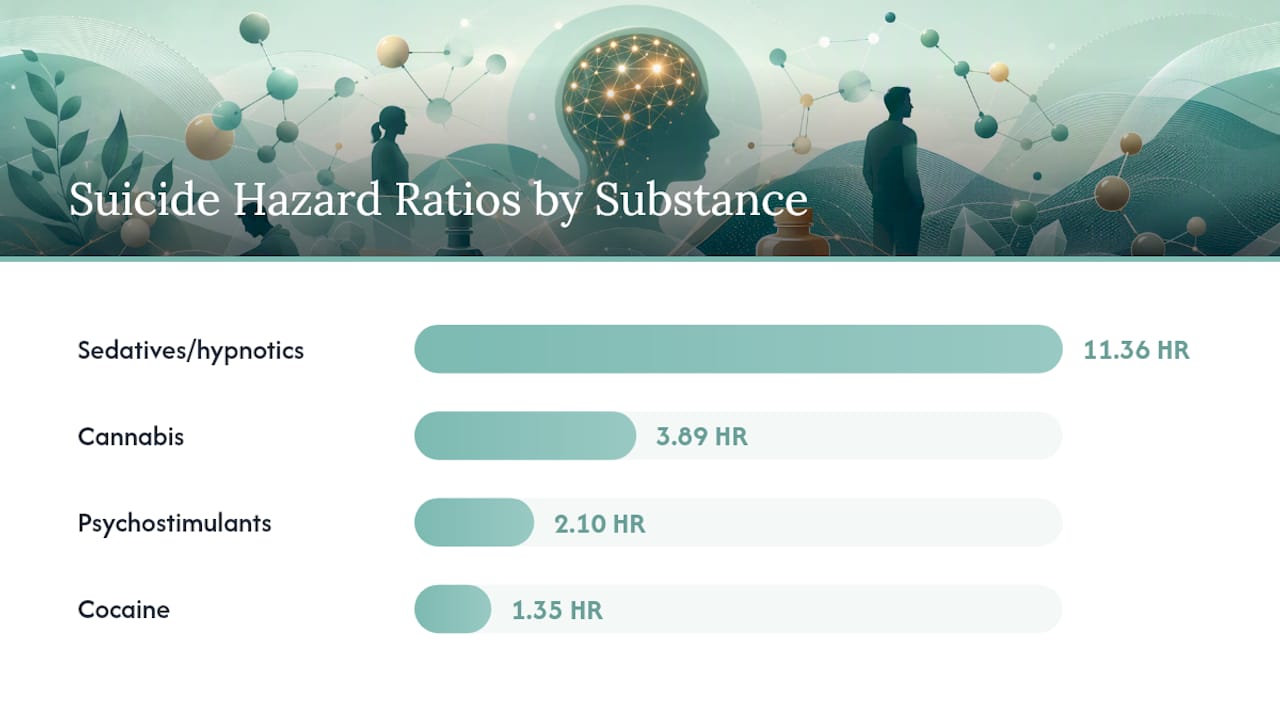
| Substance | Suicide Hazard Ratio |
|---|---|
| Sedatives/hypnotics | 11.36 |
| Cannabis | 3.89 |
| Psychostimulants | 2.10 |
| Cocaine | 1.35 |
Men with comorbid depression and alcohol use disorder face a long-term suicide risk of 16.2%, according to the same study. These are not abstract statistics; they describe the elevated probability of a fatal outcome in people who are frequently seen in primary care, emergency departments, and addiction treatment settings without receiving integrated care for both conditions.
The transition from a substance-triggered first episode of psychosis to a chronic psychotic disorder is another critical outcome metric. Clinical cohort data shows that a measurable fraction of people hospitalized for first-episode psychosis following psychedelic or amphetamine-related use later receive a schizophrenia diagnosis. This conversion rate underscores why early intervention matters and why dismissing a substance-triggered psychotic episode as “just the drugs” can be a costly clinical error.
Adolescents face disproportionate risk. The developing brain is more susceptible to the psychiatric effects of substances, and early initiation of cannabis, alcohol, or stimulants is consistently associated with worse long-term psychiatric outcomes than adult-onset use. Racial and ethnic disparities in access to integrated treatment compound these risks for communities that are already underserved by the mental health system.
How are co-occurring disorders diagnosed and treated?
The clinical starting point is always assessment, not assumption. A clinician evaluating someone with both substance use and psychiatric symptoms needs to establish the timeline: did the psychiatric symptoms appear before substance use began, during active use, only during withdrawal, or after a sustained period of abstinence? That sequence is the most important piece of diagnostic information available.
SAMHSA’s guidance is clear: integrated treatment, addressing both the substance use disorder and the psychiatric condition simultaneously, produces better outcomes than treating them sequentially. Treating depression while leaving an untreated alcohol use disorder in place is like bailing out a boat without plugging the hole.
Medications and their limits
Medications can be highly effective for primary psychiatric disorders. Antidepressants, mood stabilizers, and antipsychotics all have strong evidence bases when the underlying disorder is genuinely primary. The complication arises with substance-induced symptoms. Clinical evidence shows that antidepressants and antipsychotics are often ineffective when symptoms are driven by ongoing substance use or acute withdrawal rather than a primary disorder. This is why many clinicians prefer an observation window of several weeks of abstinence before initiating psychiatric medications, when that is clinically safe.
Medication-Assisted Treatment (MAT) is a different category. MAT uses FDA-approved medications to reduce cravings, block euphoric effects, and stabilize the neurochemistry disrupted by addiction. For opioid use disorder, MAT options include buprenorphine, methadone, and naltrexone. For alcohol use disorder, naltrexone, acamprosate, and disulfiram are the primary agents. MAT is not a substitute for psychosocial treatment; it is a foundation that makes engagement with therapy and recovery planning possible.
Why medically supervised detox matters
Withdrawal from alcohol, benzodiazepines, and opioids can be medically dangerous. Alcohol and benzo withdrawal can cause seizures and delirium tremens, a life-threatening syndrome involving severe autonomic instability. Opioid withdrawal, while rarely fatal in otherwise healthy adults, is intensely uncomfortable and is a leading driver of treatment dropout and relapse. Medically supervised detox provides the monitoring, medication management, and clinical support that make withdrawal safer and more tolerable, and it creates the stable foundation from which psychiatric assessment and integrated treatment can begin.
Finding integrated care
An integrated program screens for both substance use and psychiatric disorders at intake, treats both with a coordinated team, and builds a treatment plan that addresses the interaction between them. When evaluating a program, ask whether psychiatric assessment is part of the intake process, whether the clinical team includes both addiction medicine and mental health professionals, and whether the program offers dual diagnosis treatment rather than routing psychiatric concerns to a separate, disconnected provider.
If you are helping a family member navigate insurance coverage for integrated treatment, understanding mental health benefits in premium plans can clarify what is covered and what to ask for when calling a facility.
What does the research actually say? Key findings summarized
The 2024 NSDUH data placing 21.2 million U.S. adults with co-occurring disorders is not just a prevalence figure. It is a treatment-planning signal. Most of those individuals are not receiving integrated care; many are being treated for one condition while the other goes unaddressed, which is a primary driver of relapse and psychiatric deterioration.
The hazard-ratio data from the published meta-analysis tells a clear story about relative risk. Sedatives carry the highest suicide hazard ratio by a wide margin (11.36), followed by cannabis (3.89), psychostimulants (2.10), and cocaine (1.35). These figures should inform prescribing decisions, clinical monitoring protocols, and the urgency with which co-occurring sedative use and psychiatric symptoms are addressed together.
The clinical literature on substance-induced psychosis adds an important longitudinal dimension. A first psychotic episode triggered by a substance is not necessarily a one-time event. In clinical cohorts, a measurable proportion of people hospitalized after psychedelic-induced or amphetamine-related psychosis later receive a schizophrenia diagnosis. Early intervention, sustained monitoring, and integrated treatment during that post-episode window can meaningfully alter the trajectory.
The NCBI/NIH comorbidity research and NIMH guidance both converge on the same clinical principle: the bidirectional relationship between substance use and mental illness means that treating one without the other is rarely sufficient. The DOJ/NDIC fast facts provide accessible public-health framing that reinforces why this is a population-level concern, not just an individual one.
Key Takeaways
Alcohol, sedatives, cannabis, and stimulants carry the strongest and most consistent links to psychiatric harm, with sedatives showing the highest published suicide hazard ratio (11.36) and cannabis nearly tripling schizophrenia risk in regular users.
| Point | Details |
|---|---|
| Sedatives carry the highest suicide risk | Published hazard ratio of 11.36 makes sedative misuse the strongest substance-linked suicide predictor in the meta-analytic data. |
| Cannabis nearly triples schizophrenia risk | Regular cannabis use is associated with nearly a 3x increased risk; adolescent onset raises that risk further. |
| 21.2 million U.S. adults have co-occurring disorders | NSDUH 2024 data shows the scale of the overlap between mental illness and substance use disorder. |
| Integrated treatment outperforms sequential care | Treating both the SUD and the psychiatric condition simultaneously produces better outcomes than addressing them one at a time. |
| Emergency signs require immediate action | Psychosis, suicidal ideation, severe withdrawal, and opioid overdose all require 911 or 988, not a wait-and-see approach. |
Why integrated care changes the outcome
The clinical picture that comes up repeatedly in dual-diagnosis work is a person who has been treated for depression for years without anyone asking seriously about their drinking, or someone whose psychotic symptoms were attributed entirely to cannabis use without anyone checking whether those symptoms persisted through abstinence. Both errors are common, and both lead to the same place: inadequate treatment and preventable deterioration.
What the research makes clear is that the substances most linked to mental illness do not operate in isolation from the person using them. Genetics, trauma, developmental timing, and social context all shape how a given substance affects a given brain. That complexity is exactly why a one-size-fits-all approach fails, and why the clinical standard has moved toward individualized, integrated assessment and treatment.
A thorough intake assessment at a dual-diagnosis program will map the timeline of both the substance use and the psychiatric symptoms, screen for trauma, assess family history, and identify which symptoms are most likely substance-induced versus primary. That distinction drives medication decisions, therapy selection, and the structure of the recovery plan. It is also what makes the difference between a patient who stabilizes and one who cycles through repeated crises.
If you are at the point of recognizing that substance use and mental health symptoms are both part of the picture, the logical next step is an integrated assessment, not separate referrals to an addiction counselor and a psychiatrist who may never speak to each other. Connected Recovery’s dual diagnosis program in Van Nuys, Los Angeles provides exactly that: coordinated evaluation and treatment for both conditions, with 24/7 medical supervision and a 12-bed structure that allows for the kind of individualized attention that larger facilities rarely deliver.
This article provides general health information and is not a substitute for professional medical or psychiatric advice. Consult a qualified clinician or contact SAMHSA’s National Helpline (1-800-662-4357) for personalized guidance.
Useful sources for further reading
The following government and academic resources underpin the claims in this article. Each covers a distinct aspect of the substance-mental illness relationship.
- 2024 NSDUH Annual National Report
- PubMed indexed study reporting substance-specific suicide hazard ratios
- Cannabis use and psychosis risk — PMC article
- Common Comorbidities with Substance Use Disorders (NCBI Bookshelf, NIH)
- What are Co-Occurring Disorders? | SAMHSA
- Clinical review: substance-induced psychosis and treatment outcomes (PMC8732862)
- Substance use and mental health | NIMH
- Drug Abuse and Mental Illness Fast Facts (NDIC/DOJ)
These sources are the foundation for the rankings and clinical recommendations in this article. For treatment referrals, SAMHSA’s locator at findtreatment.gov is the most direct starting point. For research verification, NCBI/NIH’s PubMed database is the appropriate resource. None of these sources replace individualized clinical assessment.
Recommended
- Medication Assisted Treatment (MAT) in Van Nuys, CA | Connected Recovery Inc.
- What Is a Safe Detox Environment: A Clear Guide | Connected Recovery Inc.
- Why Recovery Is a Lifelong Process: What You Need to Know | Connected Recovery Inc.
- Managing Anxiety During Detox: Practical Steps for Relief | Connected Recovery Inc.
DHCS Licensed · Joint Commission Accredited
If you or a loved one is struggling with substance use, our admissions team is available to verify your insurance benefits and help you begin recovery. All calls are confidential.