
The Role of Tailored Recovery Planning in Healing

Tailored recovery planning is the process of customizing treatment strategies to match an individual’s unique substance use history, mental health needs, and personal circumstances. The clinical term for this practice is individualized treatment planning, and it sits at the center of every evidence-based recovery program worth its name. The role of tailored recovery planning goes far beyond filling out paperwork. It determines which medications you receive, which therapies run alongside them, how your progress gets measured, and what happens when setbacks occur. Regulatory bodies like SAMHSA have formalized this shift, with 42 CFR Part 8 revisions directing opioid treatment programs to use clinical judgment rather than rigid protocols when building care plans. The result is a system where your plan reflects your life, not a generic template.
How does tailored recovery planning improve treatment outcomes?
Personalized recovery plans produce measurably better results than uniform treatment approaches. The clearest evidence comes from opioid use disorder research. Combining buprenorphine with psychotherapy produced a hazard ratio of 5.26 for remission within 12 months. Buprenorphine alone reached a hazard ratio of 2.33. That gap shows what happens when treatment components are matched and layered together rather than applied in isolation.

The benefits of tailored recovery extend beyond medication decisions. When a plan integrates behavioral therapies alongside medication management, it addresses the psychological drivers of substance use at the same time as the physical ones. A person dealing with trauma-related anxiety alongside opioid dependence needs both addressed in one coordinated plan, not two separate tracks that never communicate.
Ongoing reassessment is what keeps a personalized plan effective over time. Recovery is not linear. Stressors change, living situations shift, and what worked at 90 days may need adjustment at 6 months. Clinical judgment and documentation form the backbone of genuine personalized planning, ensuring that every change in your care is linked to a clinical reason or your own input.
- Combination treatment (medication plus psychotherapy) produces the highest remission rates
- Integrated plans reduce the risk of contradicting treatment tracks
- Regular reassessment keeps plans aligned with where you actually are in recovery
- Coordinated care teams share information rather than working in silos
What are the essential components of an effective recovery plan?
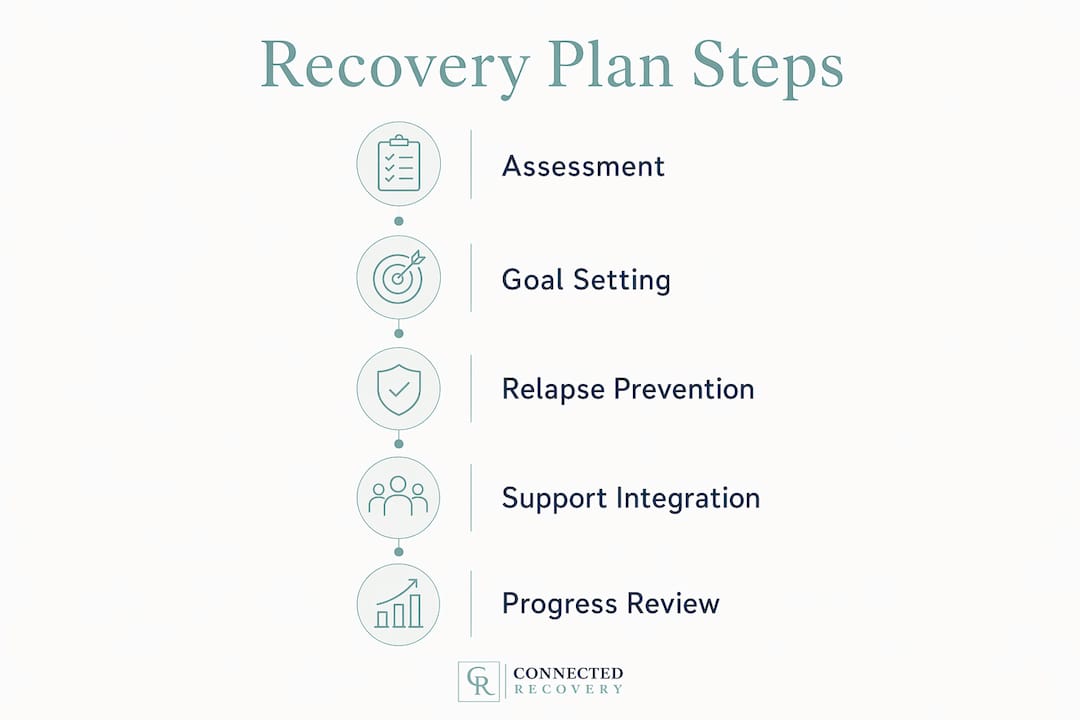
A well-built recovery plan is specific, measurable, and built with you, not for you. Treatment plans should include measurable objectives with clear criteria and defined timeframes. Vague goals like “feel better” or “use less” are not clinically useful. A goal like “attend three group therapy sessions per week for 60 days and report cravings below a 4 on a 10-point scale” gives both you and your care team something concrete to track.
Relapse prevention as a core element
Relapse prevention is not an afterthought. Effective relapse prevention plans identify your personal triggers, map out coping mechanisms for each one, and include a crisis protocol for high-risk moments. These plans function as living documents, meaning they get updated as you learn more about your own patterns. A trigger you did not recognize at intake may become obvious after your first month of treatment.
Collaboration and documentation
The plan belongs to you, but it requires a team to build well. Shared treatment planning tools allow multidisciplinary teams and clients to work on dynamic, signed, versioned care plans together. These tools capture short-term and long-term goals, track progress, and assign responsible parties so nothing falls through the cracks. Your counselor, prescribing physician, case manager, and peer support specialist should all be working from the same document.
- Set measurable goals with specific timeframes for each active problem
- Include a relapse prevention section with named triggers and coping strategies
- Add a crisis protocol with contact numbers and step-by-step instructions
- Assign a responsible party to each goal so accountability is clear
- Schedule regular review dates, at minimum every 30 days in early recovery
Pro Tip: Ask your care team to walk you through every goal in your plan before you sign it. If you cannot explain a goal in your own words, it needs to be rewritten.
One common mistake is building plans with too many goals at once. Over-complexity in recovery plans undermines practical implementation and makes accurate documentation harder. Three focused, achievable goals beat ten vague ones every time.
How do tailored plans address co-occurring mental health and substance use disorders?
Co-occurring disorders, also called dual diagnosis, affect a large portion of people seeking substance use treatment. Traditional models often treated these conditions in parallel, with a psychiatrist managing mental health and an addiction counselor managing substance use, but the two tracks rarely coordinated. That separation creates contradictions in care and gaps in support.
Integrated models for co-occurring disorders recommend unified, coordinated treatment plans built by a single clinical team. The evidence supports this approach, but current guidelines still lack sufficient evaluation of illness severity and treatment needs matching. That gap means the burden falls on you and your care team to push for true integration rather than accepting parallel care as the default.
Coordinated specialty care programs offer a strong model for what integration looks like in practice. Coordinated specialty care for first-episode psychosis combines psychotherapy, medication management, case management, family education, and employment support into one personalized plan. Service intensity adjusts dynamically based on your stability, with typical program duration running 2–5 years. That kind of flexibility, built directly into the plan’s structure, is what dual diagnosis care requires.
- Unified clinical teams prevent contradicting treatment decisions
- Illness severity staging helps match treatment intensity to actual need
- Integrated plans reduce the number of appointments and providers you must coordinate
- Dual diagnosis treatment programs at facilities like Connected Recovery address both conditions within a single care framework
What innovative tools support personalized recovery planning today?
Digital tools are changing how recovery plans get built and maintained between clinical appointments. An AI-powered chatbot designed specifically for substance use disorder recovery scored 93 on the System Usability Scale, compared to a benchmark of 68. Its Net Promoter Score reached 63, against a benchmark of 35. Those numbers reflect genuine usability, not marketing claims.
The chatbot, named Suzy, supports goal setting, craving management, and resource referrals outside of clinical hours. That matters because recovery does not pause between appointments. A person experiencing a craving at 11 p.m. on a Saturday needs support that does not require waiting until Monday morning.
Pro Tip: Use digital tools to log cravings, moods, and triggers in real time. Bring that data to your next clinical appointment. It gives your care team far more accurate information than memory alone.
Digital tools work best as supplements to human care, not replacements. The clinical effectiveness of AI chatbots in substance use recovery has not yet been fully evaluated in controlled trials. Human oversight remains non-negotiable for safety, medication decisions, and crisis response.
- AI chatbots provide between-session support for goal tracking and craving management
- Digital logging gives care teams real-time data rather than recalled estimates
- Case management services coordinate digital and human support into one continuous plan
- Dynamic, living plans updated with digital input stay more accurate over time
What practical steps can you take to build your own recovery plan?
You do not have to wait for a clinician to hand you a plan. You can walk into your first appointment with a clear sense of what you need and what you want your recovery to look like.
- Write down your three most pressing concerns before your first appointment. These become the starting points for your goals.
- Ask your provider directly whether they offer integrated care for co-occurring conditions. If they do not, ask for a referral to someone who does.
- Name your known triggers out loud during intake. Do not wait for your counselor to ask. The sooner triggers are documented, the sooner coping strategies get built around them.
- Request a copy of your treatment plan in writing. Review it within 48 hours and flag anything that does not reflect what you discussed.
- Schedule your first plan review date before you leave your intake appointment. Recovery plans that never get reviewed become outdated quickly.
Aftercare planning is part of this process from day one, not something that happens at discharge. The strongest plans include a clear picture of what support looks like after residential or intensive treatment ends.
Key takeaways
Tailored recovery planning works because it matches treatment intensity, type, and timing to your specific needs, producing better remission rates and longer-term stability than any uniform approach.
| Point | Details |
|---|---|
| Combination treatment wins | Pairing buprenorphine with psychotherapy produces a hazard ratio of 5.26 for remission, far above either alone. |
| Goals must be measurable | Vague objectives undermine clinical utility; every goal needs a timeframe and a clear success criterion. |
| Dual diagnosis needs integration | Co-occurring disorders require a unified clinical team and a single coordinated plan, not parallel tracks. |
| Digital tools fill the gaps | AI chatbots like Suzy support craving management and goal tracking between appointments but do not replace human oversight. |
| Plans are living documents | Regular review and updates keep your plan aligned with where you are in recovery, not where you started. |
What I have learned about recovery plans that most people never hear
Recovery plans get treated like intake paperwork far too often. A clinician fills one out at the start of treatment, files it, and nobody looks at it again until a regulatory audit. That is not a plan. That is a liability document wearing a plan’s clothing.
The plans that actually change outcomes are the ones that get pulled out at every session, marked up, argued over, and rewritten when the evidence demands it. I have seen people in recovery make dramatic progress not because their medication changed, but because someone finally sat down with them and asked, “Does this plan still describe your life?” That question alone can shift the entire direction of care.
The other thing most articles skip is the patient’s responsibility in this process. Personalized care is not something done to you. You have to show up with information, push back when a goal does not fit, and tell your team when something is not working. Clinicians are not mind readers. The more specific you are about your experience, the more specific your plan can be.
The future of recovery planning will almost certainly involve more digital integration, with AI tools capturing real-time data and feeding it into clinical decisions. That is promising. But the human relationship between a person in recovery and a skilled clinician remains the irreplaceable core. Technology should make that relationship more informed, not replace it.
— Jim
Connected Recovery’s approach to personalized recovery care
Connected Recovery operates as a 12-bed boutique facility in Van Nuys, CA, built specifically for people who need more than a generic treatment program. The small size is intentional. It means your care team knows your name, your history, and your plan. Every client receives a tailored treatment plan that integrates medical detox, residential care, and long-term recovery planning from the first day of admission.
Connected Recovery specializes in dual diagnosis treatment and relapse prevention, with 24/7 medical supervision and a multidisciplinary team that builds your plan with you, not around you. If you are ready to start with a program built around your specific needs, the admissions process at Connected Recovery is the right first step.
FAQ
What is tailored recovery planning?
Tailored recovery planning is the process of building a treatment plan that matches your specific substance use history, mental health needs, and personal goals. It uses clinical judgment rather than a one-size-fits-all protocol.
How does a personalized recovery plan differ from a standard one?
A personalized plan sets measurable, time-bound goals specific to your situation and includes relapse prevention strategies built around your identified triggers. Standard plans often use generic objectives that do not reflect individual circumstances.
Can a recovery plan address both addiction and mental health at the same time?
Yes. Integrated treatment plans for co-occurring disorders combine medication management, psychotherapy, and case management into one coordinated framework managed by a unified clinical team.
How often should a recovery plan be updated?
Recovery plans should be reviewed at minimum every 30 days during early treatment and updated whenever your clinical status, living situation, or goals change significantly.
Are digital tools like AI chatbots part of recovery planning?
AI chatbots can support goal tracking, craving management, and between-session check-ins, but they supplement human care rather than replace it. Clinical decisions and crisis response still require direct human oversight.
Recommended
DHCS Licensed · Joint Commission Accredited
If you or a loved one is struggling with substance use, our admissions team is available to verify your insurance benefits and help you begin recovery. All calls are confidential.