What Is the Recovery Readiness Model? A Clear Guide

The recovery readiness model is a structured framework that measures how prepared a person, family, or government is to support effective recovery across key domains. Two major bodies define this concept: the United Nations Office for Disaster Risk Reduction (UNDRR), which built a formal governmental assessment tool, and the Substance Abuse and Mental Health Services Administration (SAMHSA), which frames readiness as a self-directed process of change in addiction and mental health contexts. Understanding both versions gives you a clearer picture of how recovery readiness works and why it matters for real healing outcomes.
What is the recovery readiness model and how does it work?
The UNDRR Recovery Readiness Framework is a preparedness model designed for governments to assess their capacity to manage recovery after disasters. It organizes readiness into four domains: governance, finance, capacity, and data systems. Within those domains, the framework measures performance across 12 areas using 65 key performance indicators (KPIs). That level of specificity turns a vague concept like “readiness” into something measurable and improvable.
The framework’s core value is that it converts assessment results into concrete improvement plans. Governments use it to identify gaps, strengthen coordination, access financing, and monitor progress over time. This approach treats readiness not as a yes-or-no condition but as a spectrum with clear benchmarks. The same logic applies when you translate the model into personal or family recovery contexts.

In behavioral health, SAMHSA defines recovery as a process of change for improving health, wellness, and reaching full potential. That definition frames readiness as ongoing engagement rather than a single score. Both the UNDRR and SAMHSA models share one core principle: readiness is dynamic, not fixed.
What are the core components of the UNDRR Recovery Readiness Framework?
The UNDRR framework’s four domains each capture a distinct layer of preparedness. Governance covers the policies, laws, and institutional structures that enable coordinated recovery. Finance addresses predictable funding mechanisms and resource allocation. Capacity refers to the trained personnel, systems, and infrastructure needed to execute recovery plans. Data systems cover the monitoring and evaluation tools that track progress and inform decisions.
| Domain | Focus area | Example KPI |
|---|---|---|
| Governance | Policies and coordination | Legal frameworks for recovery mandates |
| Finance | Funding access and allocation | Pre-arranged recovery financing mechanisms |
| Capacity | Personnel and infrastructure | Trained recovery coordinators at local level |
| Data systems | Monitoring and evaluation | Post-disaster data collection protocols |
The 65 key performance indicators span all four domains and give governments a standardized way to benchmark their current state. Each KPI points to a specific gap or strength. That specificity is what separates a useful framework from a general checklist.
UNDRR’s 2025 priority actions include assessing readiness, strengthening governance, enabling predictable financing, fostering partnerships, and localizing recovery through community leadership. These actions reinforce that readiness is not a one-time audit. It requires ongoing attention, multi-sector cooperation, and community-level engagement to build genuine resilience.
Pro Tip: Transforming assessment results into a written improvement plan with assigned responsibilities and deadlines is what separates effective readiness efforts from assessments that collect dust. The same principle applies whether you are a government agency or a family supporting a loved one in recovery.
How does the recovery readiness model relate to addiction and mental health?
In addiction and mental health contexts, there is no single standardized recovery readiness model equivalent to UNDRR’s governmental tool. Instead, readiness focuses on motivation to change, operationalized most clearly through the Transtheoretical Model. That model describes five stages: precontemplation, contemplation, preparation, action, and maintenance. Each stage reflects a different level of readiness to engage with change.
A 2025 study found that motivational readiness inversely relates to relapse risk. Higher readiness lowers relapse risk, but ambivalence remains common among high-risk individuals. That finding matters because it means readiness is not a stable trait you achieve once. It shifts, and clinical support must shift with it.
Key differences between the two models include:
- UNDRR model: Quantitative, domain-based, government-facing, uses standardized KPIs
- Behavioral health model: Qualitative, motivation-centered, individual-facing, uses stage-based assessment
- Shared principle: Both treat readiness as measurable, improvable, and requiring ongoing monitoring
The practical takeaway for families is that UNDRR’s domains inspire useful personal readiness components. Governance translates to having clear agreements and roles within a family support system. Finance maps to removing practical barriers like transportation or insurance. Capacity reflects the skills and knowledge a person and their support network bring to recovery. Data systems become the habit of tracking progress and noticing early warning signs.
Pro Tip: Treat readiness as a living condition, not a destination. A person can move from the action stage back to contemplation after a stressful life event. Recognizing that shift early and responding with support rather than judgment keeps the recovery process moving forward.
What practical steps can individuals and families take to build recovery readiness?
Recovery readiness at the personal and family level centers on four components: motivation, support networks, practical barrier removal, and relapse risk planning. SAMHSA’s recovery framework suggests tracking observable progress in self-direction, wellness, and potential achievement as practical readiness markers. These are things families can actually see and respond to.
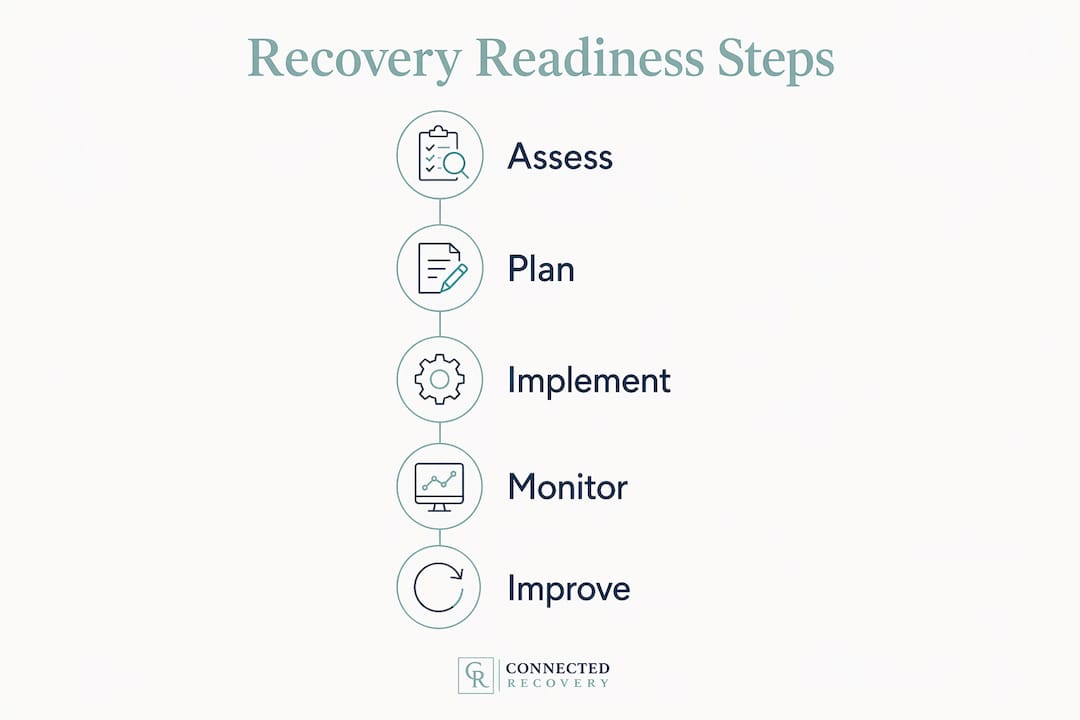
Start by assessing where the person currently sits in the change process. Are they still ambivalent, or are they actively preparing? That answer shapes every other decision. A person in the contemplation stage needs different support than someone in the maintenance stage.
Practical steps to strengthen readiness at home:
- Map the support network. Identify who provides emotional support, practical help, and accountability. Gaps in the network are gaps in readiness.
- Remove logistical barriers. Transportation, childcare, work schedules, and insurance issues reduce engagement. Address them before they become reasons to disengage.
- Create a relapse response plan. Know the warning signs, agree on what to do if they appear, and have contact information for clinical support ready. Connected Recovery’s relapse prevention programs offer structured frameworks for this planning.
- Track progress visibly. Use a simple journal, app, or weekly check-in to note changes in mood, behavior, and engagement. Progress that is visible is progress that motivates.
- Build self-directed wellness habits. Sleep, nutrition, physical activity, and social connection all support the neurological conditions that make sustained recovery possible.
Pro Tip: Hold a brief weekly family check-in focused on what is working, not just what is going wrong. Families that celebrate small wins build the kind of positive momentum that sustains long-term recovery.
How does recovery readiness improve outcomes and resilience?
Recovery readiness directly improves treatment engagement, reduces relapse risk, and builds the kind of resilience that sustains long-term change. The 2025 PMC research confirms that higher motivational readiness correlates with lower relapse risk. That relationship means investing in readiness before and during treatment pays measurable dividends.
Readiness also improves coordination. When a person, their family, and their clinical team share a common understanding of where the person stands in the change process, they can align their efforts. Misalignment, where a clinician pushes action-stage strategies on someone still in contemplation, wastes time and erodes trust.
Benefits individuals and families can expect from applying recovery readiness principles:
- Clearer communication between the person in recovery and their support network
- Earlier identification of relapse warning signs through consistent monitoring
- Reduced frustration from mismatched expectations about pace and progress
- Stronger sense of agency for the person in recovery, which supports self-direction
- Better use of clinical resources by matching interventions to actual readiness level
Adaptive monitoring is the piece most families overlook. Readiness in addiction recovery is dynamic, cycling between ambivalence and commitment. Treating it as fixed after an initial assessment leads to missed signals. Regular, low-pressure check-ins keep the picture current and the response timely.
Key Takeaways
The recovery readiness model is most effective when applied as a continuous, monitored process rather than a one-time assessment, whether at the governmental or personal level.
| Point | Details |
|---|---|
| Two distinct models exist | UNDRR’s framework targets governments; SAMHSA’s approach targets individuals in behavioral health recovery. |
| Readiness is dynamic | Motivational readiness shifts over time, requiring ongoing support rather than a single assessment. |
| Four domains guide planning | Governance, finance, capacity, and data systems apply at both systemic and personal recovery levels. |
| Higher readiness lowers relapse risk | Research links motivational readiness inversely to relapse risk, making it a measurable recovery asset. |
| Families can track observable progress | Self-direction, wellness improvement, and goal achievement are practical readiness markers for home use. |
Why I think most families misunderstand recovery readiness
Most families I have seen approach recovery readiness as a checklist. They find a treatment program, confirm insurance coverage, and assume the work is done. That is governance and finance without capacity or monitoring. It is half a framework.
The harder truth is that readiness lives inside the person in recovery, and it moves. A person who enters treatment with strong motivation can lose it after a difficult week. A person who seemed ambivalent can shift into genuine commitment after a single honest conversation. Families who understand this stop interpreting setbacks as failure and start treating them as information.
What I have found actually works is building a small, consistent feedback loop. Not a formal assessment every month, but a regular, honest conversation about how things feel. That habit catches motivational drift early. It also signals to the person in recovery that their inner state matters to the people around them, which is itself a readiness-building intervention.
The UNDRR framework, designed for governments, gets one thing exactly right: readiness requires monitoring and adaptive improvement, not just initial preparation. That principle translates directly to family support. Build the system, then keep checking whether it is working. Adjust when it is not. That is what sustainable recovery actually looks like in practice.
— Jim
Connected Recovery’s programs and your recovery readiness
Building recovery readiness takes more than good intentions. It takes structured clinical support, personalized planning, and a team that understands where you are in the change process.
Connected Recovery offers medical detox as the foundation for initial readiness, followed by residential treatment, relapse prevention, and aftercare planning. With a 12-bed capacity and 24/7 medical supervision, the facility provides the individualized attention that larger centers cannot match. Every treatment plan is built around the person’s current readiness level, not a generic protocol. If you or someone you love is ready to take the next step, Connected Recovery’s admissions team can help assess where to start.
FAQ
What is the recovery readiness model?
The recovery readiness model is a structured framework that measures preparedness for effective recovery across key domains such as governance, finance, capacity, and data systems. UNDRR applies it to governments; SAMHSA applies the underlying principles to individual addiction and mental health recovery.
How does the Transtheoretical Model relate to recovery readiness?
The Transtheoretical Model defines five stages of change: precontemplation, contemplation, preparation, action, and maintenance. These stages operationalize motivational readiness in behavioral health, helping clinicians and families match support strategies to where a person actually is in the change process.
Does higher readiness really reduce relapse risk?
Yes. A 2025 study published on PubMed Central found that motivational readiness inversely correlates with relapse risk. Higher readiness lowers the likelihood of relapse, though ambivalence remains common and requires ongoing motivational support.
Can families use recovery readiness principles at home?
Families can apply readiness principles by mapping support networks, removing practical barriers, creating relapse response plans, and tracking observable progress in self-direction and wellness. SAMHSA’s recovery definition provides a practical framework for identifying these markers at home.
What is the difference between UNDRR and SAMHSA recovery readiness?
UNDRR’s model is a quantitative, government-facing tool using 65 KPIs across four domains. SAMHSA’s approach is a qualitative, individual-facing framework centered on motivation and self-directed change. Both treat readiness as dynamic and continuously improvable.
Recommended
DHCS Licensed · Joint Commission Accredited
If you or a loved one is struggling with substance use, our admissions team is available to verify your insurance benefits and help you begin recovery. All calls are confidential.