Admit Yourself to Treatment Privately: A Step-by-Step Guide
To admit yourself to treatment privately, call a residential facility’s admissions line directly, state that you are seeking a confidential self-admission, and ask them to verify your insurance benefits before you commit to anything. That single call, protected under HIPAA, starts the process. Connected Recovery’s admissions team is available to walk you through every step with 24/7 medical supervision ready from day one.
Quick TLDR:
- Call admissions and request a confidential intake.
- Ask for private insurance verification and a written cost estimate.
- Arrange discreet transport and a low-visibility arrival time.
- Expect same-day to about one-week admission depending on bed availability and clinical need.
Table of Contents
- How do you admit yourself to private residential treatment?
- What actually happens during the clinical admission evaluation?
- How do you protect your privacy during a private admission?
- What does private residential treatment cost, and how do you verify insurance?
- What should you pack and how do you prepare before you arrive?
- What questions should you ask admissions, and what are the red flags?
- Key Takeaways
- What admissions teams actually prioritize
- Connected Recovery: confidential residential care in Van Nuys, CA
How do you admit yourself to private residential treatment?
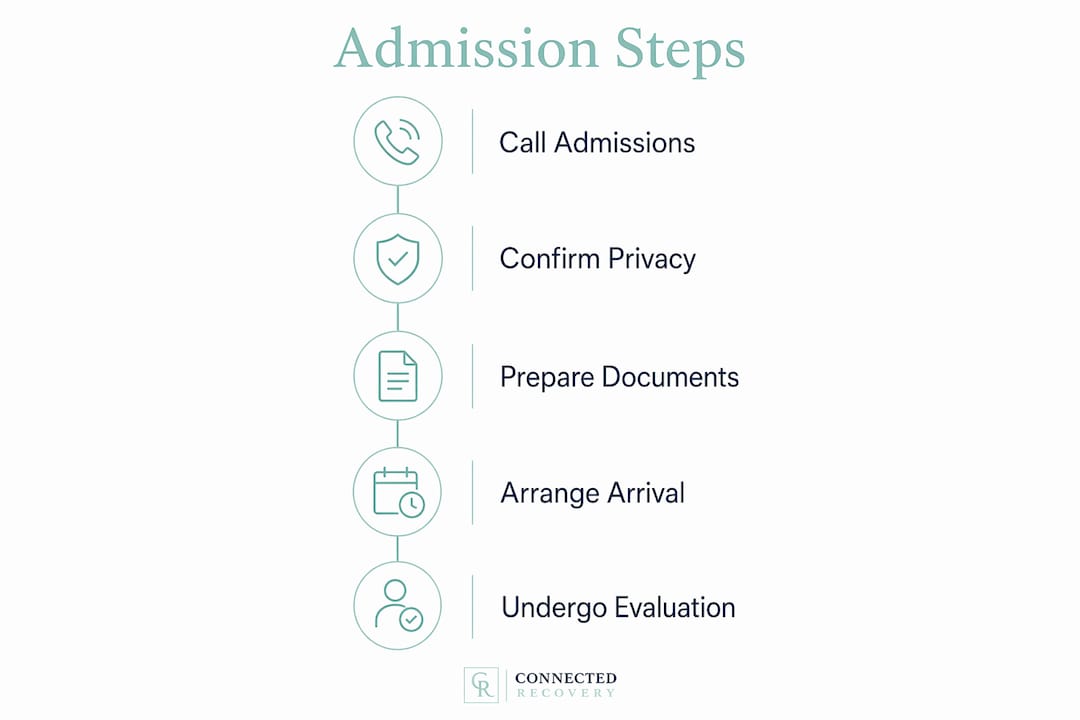
The sequence below takes you from first call to arrival. Follow it in order and you will not miss a step.
- Call admissions directly. Use the facility’s main admissions line, not a general referral hotline. Ask to speak with a single admissions counselor who will own your case. Connected Recovery’s admissions process is set up for exactly this kind of direct, confidential contact.
- State your request clearly. A simple script: “I’m calling to inquire about a confidential self-admission for residential treatment. I’d like to keep this private and would prefer to work with one contact throughout.” You do not need to over-explain.
- Request a confidential benefits verification. Ask admissions to run your insurance without generating paperwork sent to your home address. Provide your insurance ID and ask for an estimate of out-of-pocket costs before you agree to anything.
- Schedule the clinical intake evaluation. Once benefits are confirmed, admissions will schedule a clinical interview, typically within one to three business days for non-emergency cases, or the same day if withdrawal risk is present.
- Arrange transport and arrival time. Choose an off-peak arrival window (early morning or mid-week tends to minimize visibility). Confirm a neutral pickup or drop-off point if needed.
- Confirm your packing list and pre-arrival paperwork. Admissions will send a list of what to bring and any forms to complete in advance.
Timing estimate: Same-day admission is possible for urgent withdrawal cases. Standard voluntary admissions typically take several days from first call to arrival.
Pro Tip: Ask admissions to assign you a single point of contact and a direct callback number. Routing every follow-up call through a general call center increases the chance that someone else answers.
What actually happens during the clinical admission evaluation?
Admissions is not a formality. It is a clinical assessment designed to confirm that a voluntary residential setting is safe for you and that you are ready to engage in treatment. Expect a medical review, a psychiatric screen, a substance-use history, and a full medication reconciliation.
The clinical team will ask about current substances, quantities, and last use. That information drives the detox screening: if withdrawal risk is present, medically supervised detox begins immediately under 24/7 physician oversight. If detox is not clinically required, you move directly into the residential track.
What the admission process is really assessing: whether the person’s difficulties can be understood and worked with in an open, voluntary residential setting, and whether the patient has enough motivation or curiosity to participate in the work. A first call is not a commitment — it is a conversation.
Documentation admissions will typically request includes current prescriptions in original bottles, recent provider notes if available, insurance information, and one emergency contact. With your written authorization, the clinical team may contact your current prescriber to reconcile medications and bridge any controlled substances under clinical protocols.
| Stage | What happens | Typical timing |
|---|---|---|
| Initial clinical interview | Substance-use history, psychiatric screen, medical review | Day 1, on arrival |
| Detox assessment | Withdrawal risk scored; medical supervision activated if needed | Day 1–2 |
| Medication reconciliation | Current meds reviewed; controlled substances bridged | Day 1–2 |
| Individualized treatment plan | Therapy modalities, goals, and aftercare planning finalized | Day 3–5 |
How do you protect your privacy during a private admission?
HIPAA gives you the legal right to control who sees your treatment records. Start by making those rights explicit in writing on day one.
- Request a confidential communications form specifying that no calls, letters, or billing statements go to a shared address or employer.
- Ask admissions to use a discreet billing descriptor on insurance statements so the facility name does not appear on an explanation of benefits sent to your home.
- Complete a limited release of information form that names exactly who may receive updates (and what they may be told). Anyone not on that form gets nothing.
- Ask about FMLA coordination: clinical staff can help prepare employer leave paperwork that cites a medical leave without disclosing a diagnosis, with your authorization.
For arrival, choose a neutral drop-off point rather than being dropped at the front entrance. Early morning arrivals on weekdays draw less attention than weekend check-ins. Private transport services familiar with treatment admissions are an option worth asking admissions about directly. Connected Recovery’s team is experienced in protecting client reputation throughout the process.
The confidential admissions process at Connected Recovery is specifically designed for privacy-first clients, with limited-release communications and discreet billing options built in from the start.
What does private residential treatment cost, and how do you verify insurance?
Verify coverage before you commit to anything. Ask admissions to run a confidential benefits check and provide a written estimate of what your plan covers and what you will owe out of pocket.
Specific questions to ask during that call:
- Is the facility in-network with my plan?
- Does my plan require prior authorization for detox, residential, or PHP levels of care?
- Which services are covered: medical detox, residential treatment, psychiatry, medication management?
- What is my deductible status and estimated daily cost share?
| Payment option | How it works | Privacy note |
|---|---|---|
| In-network insurance | Facility bills insurer directly; prior auth usually required | EOB sent to policyholder; request discreet descriptor |
| Out-of-network with superbill | You pay upfront; facility provides detailed superbill for reimbursement | You control when and how you submit the claim |
| Private pay | Full cost paid directly; no insurance involvement | Maximum privacy; no EOB generated |
Private pay offers the highest confidentiality because no insurance claim is filed. Superbills let you seek reimbursement on your own timeline. Ask admissions whether financial assistance or payment plans are available if cost is a barrier.
What should you pack and how do you prepare before you arrive?
Bring essentials and documentation, such as comfortable clothing for several days, basic toiletries, a photo ID, your insurance card, a written list of medications with dosages, and emergency contact information. Clinical staff complete the admission evaluation on arrival and help with check-in, so you do not need to have everything figured out before you walk in.
For medications: bring every current prescription in its original labeled bottle. Notify admissions in advance about any controlled substances so the clinical team can prepare a bridging protocol if needed. Do not bring large amounts of cash, valuables, or anything you would not want stored in a secured facility.
The most useful thing you can do before arrival: call admissions the day before, confirm your arrival time, and ask if there is anything outstanding on your intake paperwork. Arriving with forms already completed cuts the administrative portion of day one significantly.
Travel tips for privacy: use a rideshare or personal vehicle rather than a facility van if visibility is a concern. Neutral luggage (no branded bags) and civilian clothing keep arrival low-profile. Ask admissions for a specific arrival window rather than showing up during a shift change.
For emotional preparation, tell one trusted person where you are going. That is enough. A brief grounding practice the morning of admission (a short walk, a few minutes of quiet) helps more than extensive planning. If anxiety is high, ask admissions to schedule a pre-arrival phone call with a counselor.

Pro Tip: Ask admissions for a first-appointment checklist before you arrive. Having a written list reduces the mental load on admission day.
What questions should you ask admissions, and what are the red flags?
Ask these before you commit:
- What are the clinical credentials of the medical and therapy staff?
- Is there 24/7 on-site medical coverage, or is a physician on-call only?
- Does the program treat co-occurring mental health conditions alongside substance use?
- What is the accreditation status of the facility?
- How are billing and insurance statements handled for privacy?
- What does discharge and aftercare planning look like?
Red flags to watch for:
- Vague or evasive answers about privacy policies or billing practices.
- No clear protocol for medically supervised detox.
- Pressure to pay in full immediately, before a written cost estimate is provided.
- No aftercare or discharge planning described during the admissions call.
- Staff unable to explain accreditation or licensing when asked directly.
A credible admissions team will answer every one of those questions clearly and without pressure. If they cannot, that tells you something important about how the program operates.
Key Takeaways
Admitting yourself to private residential treatment comes down to one call, made confidentially, with the right questions ready before you dial.
| Point | Details |
|---|---|
| Start with a direct call | Contact admissions directly, request a single counselor, and ask for confidential intake from the first conversation. |
| Verify insurance before committing | Ask admissions to run a confidential benefits check and provide a written out-of-pocket estimate. |
| Put privacy in writing | Request confidential communications, a discreet billing descriptor, and a limited release of information form on day one. |
| Arrive prepared | Bring ID, insurance card, medications in original bottles, and several days’ worth of clothing. |
| Connected Recovery | A boutique 12-bed facility in Van Nuys offering confidential admissions, 24/7 medical supervision, dual-diagnosis care, and aftercare planning. |
What admissions teams actually prioritize
The conventional framing around private treatment admission focuses almost entirely on cost and privacy logistics. Those matter. But the thing most people underestimate is how much the first call shapes the entire experience. Admissions teams at well-run facilities are not gatekeepers; they are clinical coordinators whose job is to figure out whether the setting is right for you, and to help you get there safely if it is.
The privacy piece is real and manageable. HIPAA, discreet billing, limited-release forms, and employer leave coordination are standard tools at any reputable program. What is harder to find is a facility small enough that the admissions counselor who takes your first call is also the person who checks in on you during your first week. That continuity matters clinically and practically.
A first call is not a commitment. It is a conversation. The right program will tell you honestly if they are not the right fit, and help you find one that is.
Connected Recovery: confidential residential care in Van Nuys, CA
For adults who need medically supervised detox and residential treatment without sacrificing privacy, Connected Recovery offers something most larger programs cannot: a 12-bed boutique setting where every admission is handled confidentially and every treatment plan is built around one person.
The facility provides medically supervised detox, residential treatment, integrated dual-diagnosis care, medication-assisted treatment, and structured aftercare planning. Admissions are confidential from the first call. Billing can be handled discreetly. The clinical team coordinates employer leave paperwork and discreet arrival logistics with your authorization.
With 24/7 on-site medical supervision and individualized treatment plans, Connected Recovery is built for adults who need real clinical care and real privacy at the same time. Call admissions directly for a confidential conversation about whether the program is the right fit for your situation.
This article is general information, not medical or legal advice. Confirm current clinical and insurance details with a qualified professional or the facility directly.
Recommended
DHCS Licensed · Joint Commission Accredited
If you or a loved one is struggling with substance use, our admissions team is available to verify your insurance benefits and help you begin recovery. All calls are confidential.