
Managing Anxiety During Detox: Practical Steps for Relief

Manage acute anxiety during detox by using brief grounding and breathing techniques, stabilizing your body with water and food if allowed, and alerting a clinician or support person right away. These steps work because they interrupt the nervous system’s hyperarousal loop before panic escalates. If you’re withdrawing from alcohol or benzodiazepines, behavioral techniques alone are not enough — medical supervision is required.
Do these right now if anxiety spikes:
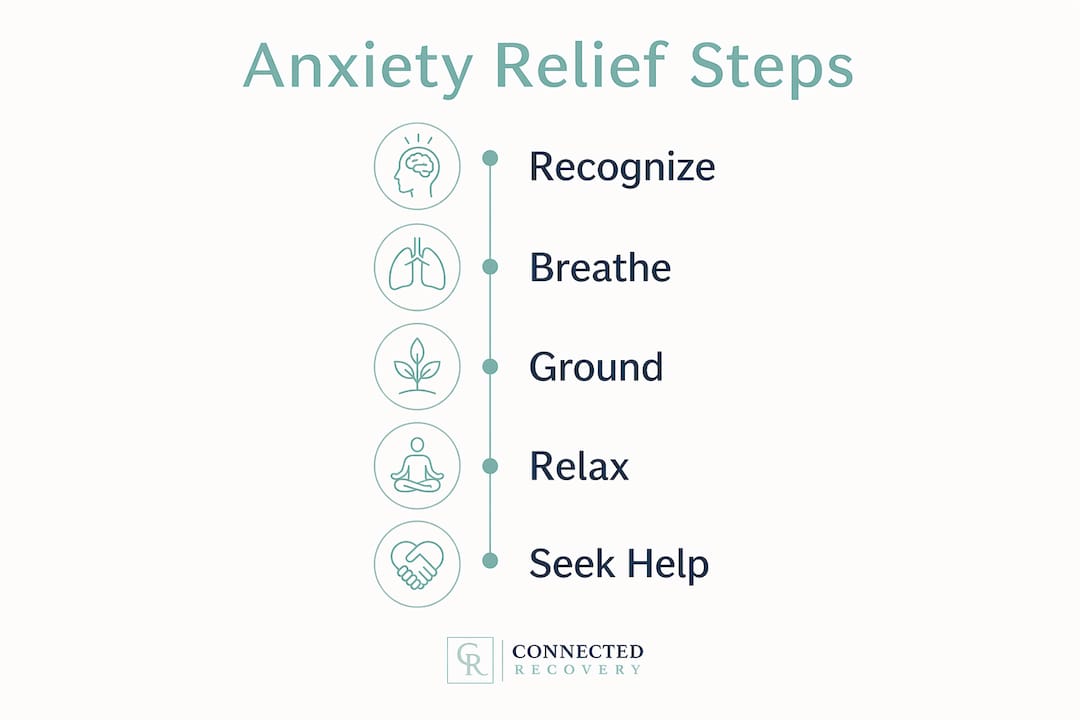
- Breathe slowly: inhale for 4 counts, hold for 4, exhale for 4 (box breathing)
- Ground yourself with the 3-3-3 rule: name 3 things you see, 3 sounds you hear, 3 body parts you can feel
- Drink water and eat a small snack if your care team permits it
- Sit or lie down in a quiet, low-stimulation space
- Call your clinician, on-call nurse, or a trusted support person immediately
- If you’re in a supervised program, press the call button or go to the nursing station
Emergency red flags — call 911 or go to the ER immediately: Seizures or convulsions, severe confusion or disorientation, visual or auditory hallucinations, a high fever that won’t break, or any thoughts of suicide or self-harm. These are medical emergencies, not anxiety symptoms to wait out.
Emotional withdrawal symptoms often begin to ease within about a week after the last use, though psychological symptoms can linger longer, especially with co-occurring disorders.
Pro Tip: Write down your current symptoms, the time of your last use, and any medications you’ve taken. That list is the first thing a clinician needs when you call.
Table of Contents
- Why does detox cause anxiety in the first place?
- What anxiety symptoms look like during withdrawal, and when to expect them
- Practical techniques you can use to reduce anxiety during detox
- When anxiety during detox becomes a medical emergency
- How professional, medically supervised detox treats anxiety
- How Connected Recovery addresses anxiety during detox
- Key Takeaways
- What integrated care actually changes in early recovery
- Connected Recovery offers medically supervised detox in Van Nuys, CA
- Useful sources and further reading
Why does detox cause anxiety in the first place?
Detox triggers nervous-system hyperarousal and often unmasks anxiety disorders that the substance was masking or suppressing. The brain adapts to the presence of a drug over time, and when that drug disappears, the nervous system overcorrects in the opposite direction.
The clearest example is the GABA/glutamate balance. Alcohol and benzodiazepines amplify GABA, the brain’s primary calming neurotransmitter. The brain compensates by downregulating GABA receptors and increasing glutamate, the excitatory counterpart. Removing the substance causes glutamate to surge unchecked, resulting in symptoms like tremors, racing thoughts, panic, and in severe cases, seizures.
The mechanism differs by substance class, though the anxiety outcome is common across all of them:
Alcohol and benzodiazepines produce the most medically dangerous withdrawal. The glutamate rebound is rapid and can escalate to delirium tremens (DTs) within a few days after the last drink or dose.
Stimulants (cocaine, methamphetamine, prescription amphetamines) cause a dopamine crash. Anxiety here comes from emotional flatness, agitation, and the brain’s reward system running on empty rather than from excitatory rebound.
Opioids trigger a norepinephrine surge when the drug is removed, producing sweating, racing heart, restlessness, and a generalized sense of dread that feels indistinguishable from a panic attack.
Nicotine withdrawal produces irritability, concentration problems, and low-grade anxiety within hours of the last cigarette. The neurological changes after nicotine cessation are real and measurable, even if the medical risk is far lower than with alcohol.
Clinical warning: Alcohol and benzodiazepine withdrawal can be life-threatening. Clinical guidelines recommend monitoring every 3–4 hours and note that seizures and psychosis typically peak 24–72 hours after the last use. Never attempt to detox from alcohol or benzodiazepines without medical supervision.
Detox also strips away the chemical buffer that many people used to manage pre-existing anxiety or trauma. Therapy approaches like CBT, DBT, and trauma-focused treatment are recommended alongside symptom management precisely because the emotional material that surfaces during detox is real, not just a side effect.
What anxiety symptoms look like during withdrawal, and when to expect them
The most common anxiety and panic symptoms during withdrawal include a racing or pounding heart, sweating, trembling hands, intrusive or catastrophic thoughts, insomnia, shortness of breath, and full panic attacks. These can feel identical to a primary anxiety disorder because, neurologically, they largely are.
Psychological symptoms to watch for:
- Persistent worry or sense of impending doom
- Intrusive thoughts about using again or about harm
- Difficulty concentrating or feeling mentally scattered
- Emotional numbness alternating with sudden intense fear
- Irritability that feels disproportionate to the situation
Physical symptoms that often accompany them:
- Rapid heart rate and palpitations
- Sweating, chills, or hot flashes
- Muscle tension, tremors, or restlessness
- Nausea and stomach cramping
- Insomnia or fragmented sleep
Typical withdrawal and anxiety timeline by substance
| Substance | Anxiety onset | Peak window | When symptoms often ease |
|---|---|---|---|
| Alcohol | 6–24 hours after last drink | 24–72 hours (DT/seizure risk) | 5–7 days for acute symptoms |
| Benzodiazepines | 12–24 hours (short-acting); — | 48–72 hours | 1–2 weeks; protracted symptoms possible |
| Opioids | hours after the last cigarette | 48–72 hours | 5–7 days for physical symptoms |
| Stimulants | Within hours of last use | 24–72 hours | 1–2 weeks; mood symptoms linger |
| Nicotine | Within hours | 48–72 hours | weeks to months |
Physical withdrawal symptoms generally peak around 48–72 hours, while psychological symptoms can persist for weeks to months. That gap matters: many people feel physically better by day five and assume they’re through the hardest part, only to be caught off guard by anxiety, depression, or cravings that return in week two or three.
Escalate to clinical reassessment if: symptoms worsen after the expected peak window, anxiety is accompanied by confusion or hallucinations, you develop suicidal thoughts, or you experience any seizure activity. Use a symptom tracking approach to document changes so you can report them accurately to your care team.
Practical techniques you can use to reduce anxiety during detox
Prioritize quick physiological regulators first: breathing and grounding interrupt the panic loop within minutes. Then layer in structure, nutrition, and movement to stabilize the nervous system over hours and days.

Breathing techniques
Box breathing (4-4-4-4): Inhale for 4 counts, hold for 4, exhale for 4, hold for 4. Repeat 4–6 cycles. This activates the parasympathetic nervous system and slows heart rate within a few minutes.
Diaphragmatic breathing: Place one hand on your chest and one on your belly. Breathe so only the belly hand rises. Shallow chest breathing amplifies anxiety; belly breathing reverses it.
Paced breathing and grounding reduce heart rate and perceived panic in short, repeatable exercises. You don’t need a quiet room or a meditation app. You need 60 seconds and a willingness to try it.
The 3-3-3 grounding rule
When anxiety pulls you into your head, this technique pulls you back into the room. Name 3 things you can see right now. Name 3 sounds you can hear. Move 3 parts of your body — roll your shoulders, wiggle your toes, press your feet flat on the floor. It sounds simple because it is. Simple is what works when your nervous system is in overdrive.
Progressive muscle relaxation
Start at your feet. Tense each muscle group for 5 seconds, then release completely. Work upward through calves, thighs, abdomen, hands, arms, shoulders, and face. The contrast between tension and release teaches the body what “relaxed” actually feels like — something many people in active addiction have genuinely forgotten.
Sleep, nutrition, and gentle movement
Poor sleep amplifies anxiety, and anxiety wrecks sleep. Stick to a consistent sleep and wake time, keep the room cool and dark, and avoid screens for an hour before bed. On the nutrition side, structured meals, hydration, and regular activity are repeatedly recommended to reduce anxiety during detox. Low blood sugar and dehydration both mimic and worsen anxiety symptoms. Eat small, regular meals even when appetite is low.

Gentle movement — a 10-minute walk, light stretching, or chair yoga — helps burn off the physical restlessness that withdrawal produces. Avoid intense exercise if you’re medically unstable, running a fever, or experiencing heart palpitations.
Building a brief coping routine
When anxiety spikes, run through this sequence: box breathing for 60 seconds, then 3-3-3 grounding, then drink a glass of water, then contact your support person or clinician. That four-step sequence takes under five minutes and covers the physiological, cognitive, and social dimensions of the spike simultaneously.
When behavioral techniques aren’t enough: If anxiety remains severe despite consistent use of these strategies, or if it’s accompanied by physical symptoms like tremors, rapid heart rate, or insomnia that won’t resolve, that’s a signal for medication support. Clinicians have access to non-addictive agents and, where appropriate, medication-assisted treatment that can stabilize nervous-system hyperarousal safely.
Pro Tip: Keep a printed copy of your coping routine on your nightstand. At 3 AM when anxiety peaks, you won’t remember the steps — but you’ll be able to read them.
When anxiety during detox becomes a medical emergency
Seek immediate medical care if you experience seizures, severe confusion or disorientation, visual or auditory hallucinations, a persistent high fever, or any suicidal thoughts or intent. These are not anxiety symptoms to manage with breathing exercises. They are emergencies.
Red flags that require calling 911 or going to the ER:
- Any seizure or convulsion, even a brief one
- Confusion so severe you don’t know where you are or what day it is
- Seeing or hearing things that others cannot
- Fever above 101°F that persists or climbs
- Chest pain or irregular heartbeat alongside withdrawal symptoms
- Thoughts of suicide, self-harm, or harming others
- Inability to keep down fluids for more than 12 hours
Alcohol and benzodiazepine withdrawal can be life-threatening. Clinical guidelines are unambiguous: monitoring every 3–4 hours and immediate escalation protocols are standard of care for these substances. Attempting to manage alcohol or benzo withdrawal at home is a serious risk, not a personal choice.
When you contact emergency personnel or an on-call clinician, tell them: the substance(s) you used, the date and time of your last use, your current symptoms and when they started, any medications you’ve taken in the last 24 hours, and any history of prior seizures or DTs. That information determines the treatment protocol within the first few minutes of your arrival.
Professional detox prevents complications that home management cannot anticipate. A seizure during unsupervised withdrawal can cause head trauma, aspiration, or cardiac arrest. The risk is real and the window is narrow.
How professional, medically supervised detox treats anxiety
Medical supervision and integrated behavioral care together reduce both the physiological danger and the subjective suffering of detox-related anxiety. Neither alone is as effective as both combined.
Inpatient medical detox provides 24/7 nursing observation, regular vital sign monitoring, and access to medications that stabilize withdrawal symptoms. For alcohol and benzodiazepine withdrawal, clinicians use evidence-based medication protocols to prevent seizures and reduce the nervous-system hyperarousal that drives anxiety. For opioid withdrawal, medications can address the norepinephrine surge directly. A safe detox environment with low stimulation, consistent staff, and structured routines also reduces anxiety independent of medication.
Outpatient and ambulatory detox works for lower-risk withdrawals where daily or twice-daily check-ins are sufficient. Anxiety management here relies more heavily on behavioral strategies, peer support, and outpatient medication management. It’s appropriate for some stimulant and nicotine withdrawals, but generally not for alcohol or benzodiazepine dependence.
Dual-diagnosis programs address the co-occurring anxiety disorder that detox unmasks. CBT, DBT, and trauma-focused therapies are integrated into the treatment schedule rather than deferred to “after detox.” That matters because untreated anxiety is one of the strongest predictors of relapse in early recovery.
Questions worth asking any program before admission: How often will a nurse or physician assess me? What medication protocols do you use for my specific substance? Do you have on-site mental health clinicians, or is psychiatric care referred out? Is there 24/7 nursing coverage? What does aftercare planning look like, and how does it address ongoing anxiety?
Why supervised detox changes outcomes: A calm, monitored environment plus targeted medications stabilizes nervous-system hyperarousal in ways that willpower and breathing exercises simply cannot replicate for high-risk withdrawals. The goal isn’t just surviving detox — it’s arriving at the other side stable enough to engage in the recovery work that follows.
Residential detox programs offer the highest level of monitoring and the most consistent environment for managing anxiety during the acute withdrawal phase.
How Connected Recovery addresses anxiety during detox
Connected Recovery integrates medical detox with mental health care and 24/7 clinical monitoring in a 12-bed boutique facility in Van Nuys, CA. The small capacity is a deliberate clinical choice: it means every person gets consistent staff attention rather than being one of dozens on a floor.
The facility’s approach covers the full range of what the research supports:
- 24/7 clinical monitoring with nursing staff available around the clock, not just during business hours
- Medication-assisted treatment for opioid and other dependencies, with protocols designed to reduce withdrawal-driven anxiety
- Dual-diagnosis treatment that addresses co-occurring anxiety disorders alongside substance use, rather than treating them sequentially
- Individualized treatment plans built from an intake assessment that captures substance history, mental health history, and prior withdrawal experiences
- Aftercare planning that begins during detox, not after discharge
If you’re preparing for admission, having the following ready speeds up the intake process significantly: a list of all substances used and approximate amounts, the date and time of your last use, current prescription medications and dosages, any history of prior withdrawals or seizures, insurance information or payment details, and emergency contact information for a trusted family member or friend. Families supporting someone through this process can also benefit from a mental health support checklist to understand what to expect and how to help.
Connected Recovery’s detox resources explain what to expect at each stage of withdrawal, which helps reduce the anticipatory anxiety that often makes the first 24 hours harder than they need to be. For a full explanation of what medical detox involves, the medical detoxification guide covers assessment, monitoring, and care coordination in plain language.
Key Takeaways
Managing anxiety during detox requires immediate coping techniques, clear knowledge of escalation signs, and medical supervision for alcohol or benzodiazepine withdrawal.
| Point | Details |
|---|---|
| Act on anxiety immediately | Use box breathing and 3-3-3 grounding first, then contact your clinician or support person. |
| Know the peak window | Physical withdrawal symptoms generally peak around 48–72 hours; psychological symptoms can persist for weeks to months. |
| Alcohol and benzo withdrawal is a medical emergency | Seizures and DTs typically peak 24–72 hours after the last use — never attempt these withdrawals without supervision. |
| Layer your coping strategies | Combine breathing, grounding, sleep hygiene, nutrition, and gentle movement into a brief daily routine. |
| Connected Recovery | Provides 24/7 monitored medical detox with integrated dual-diagnosis care in a 12-bed facility in Van Nuys, CA. |
What integrated care actually changes in early recovery
The conventional framing around detox anxiety treats it as a symptom to endure. Get through the physical peak, the thinking goes, and the anxiety resolves on its own. That framing is wrong in two important ways.
First, for alcohol and benzodiazepine withdrawal, anxiety is not just discomfort — it’s a signal of neurological instability that can escalate to seizures without warning. Waiting it out without monitoring is a gamble with genuinely bad odds. The clinical evidence here is not ambiguous.
Second, the anxiety that surfaces during detox is often the same anxiety that drove the substance use in the first place. Detox strips away the chemical buffer, and what’s left is the original problem, now unmedicated and acute. Treating that with breathing exercises alone is like treating a broken leg with ibuprofen. It helps at the margins. It doesn’t fix the underlying issue.
What actually changes outcomes is the combination: medical stabilization that addresses the neurological crisis, and behavioral and psychiatric care that addresses the psychological one. Programs that defer mental health treatment until “after detox is complete” are missing the window when that work is most needed and most impactful. The anxiety a person feels on day three of detox is the same anxiety they’ll feel on day thirty if no one addresses it directly.
The other thing that gets underestimated is environment. A quiet, consistent, low-stimulation space with staff who know your name and your history reduces anxiety in ways that are hard to quantify but easy to feel. That’s not a luxury feature. It’s a clinical variable.
Connected Recovery offers medically supervised detox in Van Nuys, CA
For people withdrawing from alcohol, benzodiazepines, opioids, or stimulants, Connected Recovery provides medically supervised detox with 24/7 clinical monitoring, integrated mental health care, and medication-assisted treatment options in a 12-bed facility in Van Nuys, CA.
The facility accepts private pay and many insurance plans. Services include medical detox, residential treatment, dual-diagnosis care, MAT, and structured aftercare planning to support anxiety management well beyond the acute withdrawal phase. For questions about insurance coverage, the insurance navigation guide walks through the verification process step by step.
To find out whether Connected Recovery is the right fit for your situation, call the admissions team directly or visit the programs page to review available levels of care and start the intake process.
This article is general information, not medical advice. For alcohol or benzodiazepine withdrawal, or if you are experiencing suicidal thoughts, contact a medical professional or call 911 immediately.
Useful sources and further reading
The most authoritative clinical sources for detox-related anxiety are SAMHSA, NCBI clinical guidelines, and peer-reviewed literature on withdrawal management. The following resources cover the clinical detail, practical guidance, and local care options referenced throughout this article.
- SAMHSA National Helpline — Free, confidential, 24/7 treatment referral and information service for substance use and mental health disorders.
- NCBI: Substance Withdrawal Syndrome — Clinical overview of withdrawal syndromes by substance class, including anxiety and autonomic symptoms.
- NCBI: Withdrawal Management Guidelines — Primary clinical reference for monitoring protocols, seizure/DT risk windows, and symptomatic medication recommendations.
- PMC: Anxiety and Substance Use Disorders — Peer-reviewed research on the co-occurrence of anxiety disorders and substance use and implications for treatment.
- NCBI: Opioid Withdrawal — Clinical guidance on opioid withdrawal symptoms, timeline, and management options.
- NCBI: Alcohol Withdrawal — Detailed clinical reference for alcohol withdrawal severity, DT risk factors, and treatment protocols.
- Connected Recovery: Medical Detox in Van Nuys, CA — Details on the facility’s medically supervised detox program, monitoring protocols, and admission process.
- Connected Recovery: Detox Withdrawal Symptoms — Practical overview of what to expect physically and emotionally during withdrawal, with guidance on when to escalate care.
Recommended
DHCS Licensed · Joint Commission Accredited
If you or a loved one is struggling with substance use, our admissions team is available to verify your insurance benefits and help you begin recovery. All calls are confidential.