
What Is a Private Residence Rehab? Your Clear Guide
A private residence rehab is a privately funded, live-in treatment program that provides 24/7 clinical care and individualized addiction treatment. You stay on site, away from the triggers of daily life, while a clinical team manages everything from medical detox through discharge planning. Unlike government-funded or state-run programs, access depends on private insurance or out-of-pocket payment rather than a Medicaid eligibility determination or a waiting list. That funding difference is what shapes the staffing ratios, the amenities, and how much the program can be tailored to you specifically.
If you or someone you care about is weighing whether this level of care makes sense, this guide covers the full picture: how private residential rehab compares to other levels of care, what a typical program looks like day to day, realistic costs, insurance steps, and what to look for when choosing a facility.
Table of Contents
- What sets private residential rehab apart from public programs?
- Where does private residential care fit in the continuum of care?
- What does a typical private residential program look like day to day?
- Who is private residential rehab actually right for?
- How long does private residential rehab last?
- What does private residential rehab cost, and how does insurance work?
- What does the evidence say about residential rehab effectiveness?
- How do you choose the right private residential program?
- What the admission process looks like at a boutique private residential program
- Key Takeaways
- The thing most people get wrong about private residential rehab
- Connected Recovery is a concrete next step, not just a name to Google
- Authoritative sources and further reading
What sets private residential rehab apart from public programs?
Residential treatment is a live-in program where patients receive therapy, medical care, and structured support in an alcohol- and drug-free setting. The “private” part refers to how it’s funded and who runs it, not just the physical setting.
Defining features of private residential rehab:
- Live-in care with 24/7 clinical supervision
- Funded by private insurance or direct client payment (not Medicaid or state block grants)
- Smaller census, often 12 beds at boutique facilities
- Individualized treatment tracks rather than one-size programming
- Shorter or no wait times compared with publicly funded programs
- Optional private rooms, amenities, and specialized therapeutic offerings
Because private facilities don’t depend on government reimbursement rates, they can maintain lower client-to-staff ratios and offer more diverse treatment tracks. That matters most for people with complex co-occurring disorders or those who’ve cycled through less intensive care without lasting results.
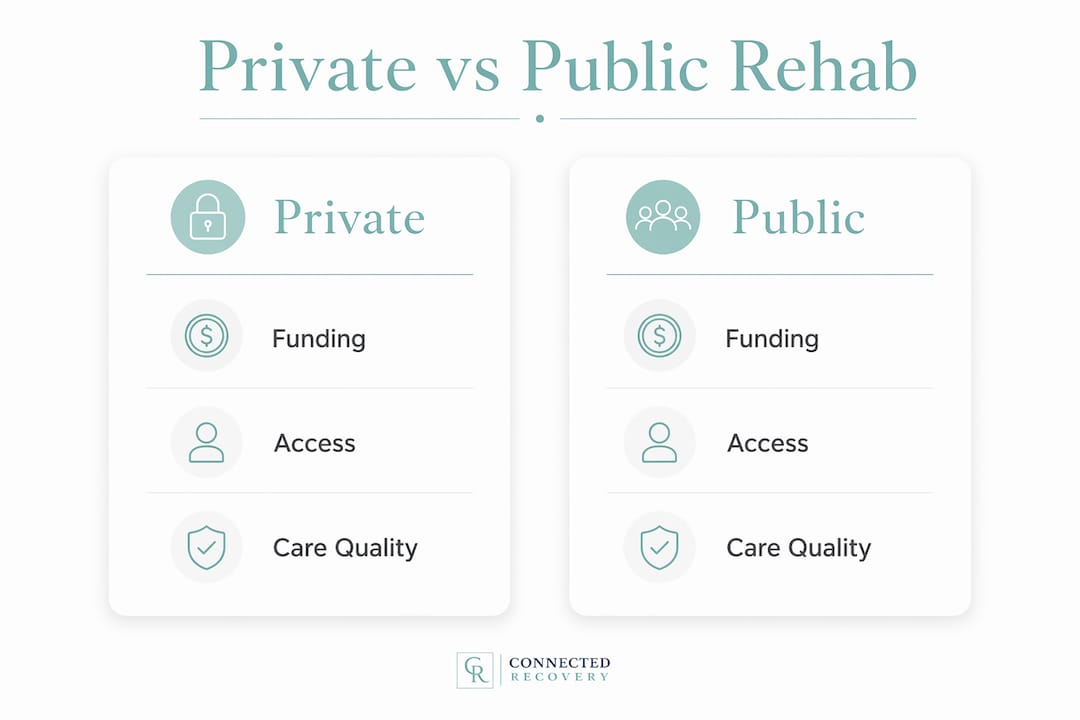
| Feature | Private Residential | Public/State-Funded |
|---|---|---|
| Funding | Private insurance or self-pay | Medicaid, state grants, or sliding scale |
| Wait time | Usually days to a week | Weeks to months in many markets |
| Bed count | Often 12 | Frequently 20–100 |
| Staff-to-client ratio | Lower (more individualized) | Higher (less individualized) |
| Programming flexibility | Tailored tracks, specialty therapies | Standardized protocols |
| Privacy | High; private rooms common | Shared rooms standard |
| Cost to client | Higher out-of-pocket if uninsured | Low or no cost for eligible clients |

The trade-off is straightforward: private programs cost more but typically offer faster access, more personalized care, and greater confidentiality.
Where does private residential care fit in the continuum of care?
Understanding the levels of care helps you decide whether residential is the right fit or whether a different level would serve you better.
| Level of Care | Setting | Supervision | Medical Capability | Typical Patient Profile |
|---|---|---|---|---|
| Hospital inpatient | Acute care hospital | 24/7 physician-led | Full medical/psychiatric stabilization | Severe withdrawal, acute psychiatric crisis |
| Residential (private) | Live-in facility | 24/7 nursing + on-call physician | Detox, medication management, therapy | Moderate-to-severe SUD, failed outpatient, unstable home |
| Partial hospitalization (PHP) | Day program, patient sleeps elsewhere | Daytime clinical staff | Intensive therapy, limited medical | Step-down from residential, stable housing |
| Intensive outpatient (IOP) | Outpatient clinic | Scheduled sessions only | Therapy, MAT coordination | Mild-to-moderate SUD, stable environment |
| Standard outpatient | Clinic or telehealth | Weekly or biweekly | Therapy, prescribing | Early-stage or maintenance phase |
“Residential” and “inpatient” are often used interchangeably in everyday conversation, but clinically they differ. Hospital inpatient care is for acute medical or psychiatric crises that require full hospital infrastructure. Residential care, including private residential programs, is for people who are medically stable enough to live in a structured facility but need more support than any outpatient setting can provide.
What does a typical private residential program look like day to day?
The structure varies by facility, but most private residential programs follow a recognizable clinical arc.

Medical detox
Detox is usually the first phase when physical dependence is present. At facilities with on-site medical detox, a physician and nursing staff manage withdrawal symptoms, monitor vitals, and prescribe medications to reduce discomfort and risk. Not every residential facility runs detox in-house; some refer patients to a hospital or detox unit first, then transfer them once medically stable.
Core therapies
Individual therapy using cognitive behavioral therapy (CBT) is the backbone of most evidence-based programs. Group therapy runs daily, covering topics from relapse triggers to communication skills. Family therapy is offered at most quality programs, typically starting in the second or third week. Some facilities also incorporate motivational enhancement therapy (MET) and contingency management, both of which have strong research support for substance use disorders.
Medication-assisted treatment (MAT)
For opioid use disorder, buprenorphine and naltrexone are the primary medications used in residential settings; methadone maintenance typically requires a federally licensed opioid treatment program and is usually coordinated as a referral. For alcohol use disorder, naltrexone and acamprosate are commonly prescribed. A reputable facility will have a prescribing physician on staff and a clear policy on MAT availability rather than treating medication as a last resort.
A typical day
Morning usually starts with a community meeting or mindfulness group, followed by individual therapy sessions and structured group programming through midday. Afternoons often include skills-building groups, recreational therapy, or 12-step meetings. Evenings are lighter, with peer support time, journaling, or optional groups. Nightly check-ins with nursing staff close the day.
Pro Tip: Ask specifically whether a physician is on call overnight and on weekends, not just during business hours. Withdrawal complications don’t follow a 9-to-5 schedule, and the answer tells you a lot about the facility’s actual medical commitment.
Dual-diagnosis care, meaning treatment for both a substance use disorder and a co-occurring mental health condition like depression or PTSD, should be integrated rather than sequential. Ask whether the psychiatrist is on staff or a contracted consultant who visits once a week.
Who is private residential rehab actually right for?
Private residential rehab fits a specific clinical profile. It’s not the starting point for everyone, and it’s not the right level for everyone either.
Profiles that commonly fit residential care:
- Prolonged heavy use with physical dependence requiring supervised detox
- One or more outpatient treatment attempts that didn’t hold
- Co-occurring mental health conditions (anxiety, depression, PTSD, bipolar disorder) that complicate outpatient management
- An unstable or triggering home environment that makes recovery at home unrealistic
- Strong motivation but a need for structure and removal from daily stressors
Admission screening typically covers medical history, substance use history, current psychiatric stability, and a commitment to treatment. Most programs require that a prospective patient be medically stable enough for a residential setting. Someone experiencing severe alcohol withdrawal with seizure risk, acute suicidality, or a medical emergency needs hospital-level care first.
Residential care is also not appropriate as a substitute for ongoing psychiatric hospitalization. If someone’s primary presenting issue is an acute psychiatric crisis rather than addiction, a psychiatric inpatient unit is the right first step.
How long does private residential rehab last?
Program length varies, and the right duration depends on the substance involved, the severity of dependence, co-occurring conditions, and insurance coverage.
Common program lengths:
- 7–30 days: Short stabilization stays, often focused on detox and initial stabilization. Clinically limited for most moderate-to-severe presentations.
- 30–90 days: The standard residential range. Enough time for detox, active therapy, and the beginning of behavioral change.
- 90+ days: Extended residential or therapeutic community models. Some nonprofit programs run 180-day residential work-therapy models that add vocational and social rehabilitation alongside addiction treatment.
Research consistently supports longer stays producing better outcomes. The National Institute on Drug Abuse has long cited 90 days as a meaningful threshold, with studies showing that patients who complete longer treatment episodes have lower relapse rates than those who leave earlier.
A typical phased timeline looks like this: medical detox (days 1–7, if needed), stabilization and assessment (days 7–14), active therapy (weeks 2–8+), and transition planning with aftercare coordination in the final weeks. What cuts a stay short most often is insurance authorization limits, not clinical readiness. Knowing this in advance lets you plan for a step-down to partial hospitalization or intensive outpatient rather than going home with no support structure.
What does private residential rehab cost, and how does insurance work?
Cost is the question most people ask first and research last. Getting ahead of it saves real money and prevents placement delays.
Private residential rehab in the U.S. varies widely in price depending on amenities, geographic market, staffing model, and length of stay. Luxury programs in high-cost markets can run significantly higher than standard clinical programs. The Affordable Care Act requires most private insurance plans to cover substance use disorder treatment, and the Mental Health Parity and Addiction Equity Act requires that coverage be comparable to medical and surgical benefits.
Steps to verify your insurance coverage:
- Call the member services number on the back of your insurance card and ask specifically about residential substance use disorder benefits.
- Request pre-authorization before admission; most insurers require it for residential placement.
- Ask the facility for the relevant CPT or DRG codes they bill under so you can confirm coverage with your insurer before you commit.
- Confirm your deductible, out-of-pocket maximum, and whether the facility is in-network.
- Ask the facility how they handle insurance billing privacy — specifically, who receives the Explanation of Benefits (EOB) and whether you can request that it go directly to you rather than a shared household address.
For those without adequate insurance coverage, options include sliding-scale fees at some programs, personal loans or healthcare financing, employer assistance programs (EAP), and VA benefits for eligible Veterans. VA residential rehabilitation programs offer comprehensive, 24/7 structured care for Veterans, often integrating medical, vocational, and housing support at no cost to the Veteran.
Pro Tip: Ask the admissions coordinator to walk you through the billing process before you sign anything. Specifically ask: “Will my insurer send an EOB to my home address, and can I redirect it?” This one question protects your privacy if others in your household don’t know you’re seeking treatment.
What does the evidence say about residential rehab effectiveness?
Residential treatment works for many people, but outcomes depend heavily on what happens during and after the program.
Research published in the Journal of Substance Abuse Treatment and supported by SAMHSA consistently shows that treatment completion, longer length of stay, and participation in aftercare are among the strongest predictors of sustained recovery. Programs that integrate aftercare, including sober living, outpatient therapy, and vocational support, report better continuity and lower short-term relapse rates.
Key factors that improve outcomes:
- Length of stay: Completing a full program, especially 90+ days, is associated with better outcomes than early discharge.
- Evidence-based therapies: CBT, MET, and contingency management have the strongest research support for substance use disorders.
- Aftercare integration: Aftercare planning that includes sober living referrals, alumni support, and outpatient follow-up significantly reduces the risk of relapse in the months after discharge.
- MAT access: Medication access for opioid and alcohol use disorders, where clinically indicated, improves retention and reduces overdose risk.
- Family involvement: Programs that engage family members in therapy show better long-term outcomes than those that treat the patient in isolation.
When a facility quotes you a “success rate,” ask how they define success, over what time period they measured it, and whether outcomes were tracked by an independent party. A 30-day self-reported sobriety rate and a 12-month independently verified abstinence rate are very different numbers.
How do you choose the right private residential program?
The difference between a well-run program and a poorly run one isn’t always obvious from a website. Here’s what to actually look for.
Essential credentials and trust signals:
- State licensure as a residential treatment facility (required in every U.S. state)
- Accreditation from CARF International or The Joint Commission
- A licensed medical director and 24/7 nursing coverage
- Licensed clinical staff (LCSW, LMFT, licensed psychologist, or equivalent) delivering therapy
- Clear, written policies on MAT, dual-diagnosis treatment, and discharge planning
Questions to ask when you call admissions:
| Question | Why It Matters |
|---|---|
| Is the facility CARF or Joint Commission accredited? | Confirms independent quality review |
| What is your client-to-staff ratio? | Lower ratios mean more individualized attention |
| Do you offer MAT for opioid or alcohol use disorder? | Critical for evidence-based care |
| How do you handle co-occurring mental health conditions? | Reveals whether dual-diagnosis care is integrated or siloed |
| What does your aftercare plan look like at discharge? | Predicts continuity of care post-discharge |
| How do you handle insurance billing and EOBs? | Protects privacy and prevents billing surprises |
| What are your outcome measurement practices? | Distinguishes programs that track results from those that don’t |
Red flags to watch for:
- Vague or unverifiable outcome claims (“95% success rate” with no methodology)
- Pressure to sign admission paperwork or pay a deposit before you’ve asked all your questions
- No physician on staff or no clear plan for managing medical detox
- Locked facilities without a clear, legally grounded explanation
- Resistance to answering questions about staff credentials or accreditation
A step-by-step admissions guide from a reputable facility should walk you through exactly what to expect before and on the day of intake.
What the admission process looks like at a boutique private residential program
Using Connected Recovery Inc. as a concrete example helps illustrate what a well-structured boutique admission actually involves.
Connected Recovery operates a 12-bed residential program in Van Nuys, California, with an integrated care model that runs from medical detox through aftercare planning. The small census is deliberate: it allows for individualized treatment tracks and a lower client-to-staff ratio than most larger facilities can maintain.
Typical admission flow:
- Initial assessment: A clinical intake coordinator conducts a confidential phone or in-person assessment covering substance use history, medical history, and psychiatric status.
- Medical clearance: A physician reviews the assessment to determine whether on-site detox is appropriate or whether a hospital-level detox is needed first.
- Intake day: The client arrives, completes paperwork including HIPAA authorizations, and meets the clinical team. Personal belongings are reviewed per facility policy.
- Care planning: Within the first 72 hours, the treatment team develops an individualized care plan covering therapy goals, MAT decisions, family involvement, and discharge targets.
- Family involvement: Family sessions are scheduled once the client is stabilized, typically in the second week.
- Discharge and aftercare: Discharge planning begins early and includes referrals to sober living, outpatient therapy, and alumni support.
HIPAA protections apply throughout. Under federal law, a residential rehab cannot share your protected health information without your written authorization, with narrow exceptions for treatment coordination and safety. Connected Recovery’s HIPAA and confidentiality policies are published and available before admission. Ask any facility you’re considering to walk you through their specific process for handling insurance EOBs and who has access to your records.
Key Takeaways
Private residential rehab delivers the highest non-hospital level of addiction care, and choosing the right program comes down to accreditation, clinical staffing, MAT access, and a clear aftercare plan.
| Point | Details |
|---|---|
| What it is | A privately funded, live-in treatment program with 24/7 clinical supervision and individualized care |
| Who it fits | People with moderate-to-severe substance use disorder, failed outpatient attempts, or co-occurring mental health conditions |
| How long it lasts | 30–90 days is the standard range; 90+ days is associated with better outcomes |
| Insurance and cost | Most private plans must cover residential SUD treatment under the ACA and Mental Health Parity Act; verify benefits before admission |
| Connected Recovery | A 12-bed boutique program in Van Nuys, CA offering integrated care from detox through aftercare with 24/7 medical supervision |
The thing most people get wrong about private residential rehab
The most common mistake isn’t choosing the wrong facility. It’s treating admission as the finish line.
Private residential rehab is genuinely effective for the right person at the right time. The research is clear that longer stays, evidence-based therapies, and medication access all move the needle. But the data is equally clear that what happens after discharge matters just as much as what happens inside the program. People who leave a 60-day residential stay and return to the same environment, the same relationships, and no outpatient follow-up are not in a fundamentally different position than they were before admission. The program gave them tools; the aftercare plan is where those tools get used.
The second thing worth saying: boutique private programs are not automatically better than larger ones, and a high price tag is not a proxy for clinical quality. What actually predicts outcomes is accreditation, licensed clinical staff, integrated dual-diagnosis care, MAT access where indicated, and a discharge plan that doesn’t end at the front door. Ask those questions directly. A program that can’t answer them clearly is telling you something.
Before you call a program, run through this checklist:
- Confirm the facility is state-licensed and CARF or Joint Commission accredited
- Ask about the client-to-staff ratio and overnight medical coverage
- Clarify MAT policy and dual-diagnosis capability
- Request a written description of the aftercare plan
- Ask how insurance EOBs are handled and who receives them
- Get a clear picture of what a typical day looks like
Connected Recovery is a concrete next step, not just a name to Google
If the criteria above describe what you’re looking for, Connected Recovery Inc. is worth a direct conversation. The 12-bed residential program in Van Nuys, California runs the full clinical arc: medically supervised detox, individualized residential treatment, dual-diagnosis care, and structured aftercare planning, all under one roof with 24/7 medical supervision. The small census means your care plan is actually yours, not a template adjusted at the margins.
The admissions process starts with a confidential assessment, no commitment required. The team can verify your insurance benefits during that first call and walk you through the pre-authorization process so there are no billing surprises. If you’re ready to ask the questions from the checklist above, Connected Recovery’s admissions coordinators are equipped to answer all of them. Call or submit a confidential intake request at connectedrecoverycenter.com to get started.
Authoritative sources and further reading
These sources back the clinical guidance in this article and are worth bookmarking if you want to verify anything or dig deeper.
- SAMHSA National Helpline — Free, confidential, 24/7 treatment referral and information service for individuals and families facing substance use disorders. A practical first call if you’re not sure where to start.
- SAMHSA.gov — The Substance Abuse and Mental Health Services Administration publishes treatment locators, clinical guidelines, and evidence-based practice resources.
- HHS Mental Health Parity — Official HHS resource explaining your insurance rights under the Mental Health Parity and Addiction Equity Act, relevant when verifying residential coverage.
- Healthcare.gov / Affordable Care Act — Explains ACA requirements for substance use disorder coverage under marketplace and employer plans.
- VA Residential Rehabilitation — Details VA residential rehab programs for Veterans, including domiciliary care and transitional housing models.
- NCBI / PMC Research — Peer-reviewed research on residential treatment outcomes and length-of-stay effects; useful for evaluating program effectiveness claims.
- Connected Recovery Residential Treatment — Program details, care pathway, and admission information for Connected Recovery’s Van Nuys facility.
- Connected Recovery Aftercare Planning — Describes post-discharge support options including relapse prevention and alumni programming.
This article is general information, not medical or clinical advice. Treatment decisions should be made with a qualified healthcare provider based on your specific situation and current clinical guidelines.
Recommended
DHCS Licensed · Joint Commission Accredited
If you or a loved one is struggling with substance use, our admissions team is available to verify your insurance benefits and help you begin recovery. All calls are confidential.